 Lymph Plan
Quick answer: A lymphatic drainage oil is any light massage oil that lets your hands or a tool glide across the skin at the very light pressure lymph work needs. The oil does not move lymph; the strokes do. Lymph sits just under the skin and moves when the skin is gently stretched toward the nearest nodes (1, 2), so all an oil has to do is stop your fingers dragging. Jojoba, grapeseed, sweet almond or fractionated coconut oil, 3–6 drops per zone, do that job; so does a thin layer of moisturizer. The "lymphatic" oils sold online are these same carrier oils with essential oils added, and no essential oil has been shown to drain lymph, reduce swelling or "detox" anything. Buy a plain oil you like the feel of, use less than you think, and put the money into learning the strokes.
which zones puff up for you? → a 5-minute routine; the oil is optional, the strokes are not
What a lymphatic drainage oil is for
Lymphatic drainage, professional or at home, is done at the pressure of a resting hand, light enough that the skin moves over the tissue underneath without the muscle being pressed (1). At that pressure, dry skin on dry fingers drags, and dragging turns a light stroke into a pull that reddens skin and makes you press harder to keep moving. A little slip fixes that. That is the whole reason for oil in lymph work: friction control, so you can stay light and slow. Lymphatic drainage massage explains the strokes themselves; this page is about the slip.
The claim on the bottle is usually bigger. "Lymphatic drainage oil" listings promise to stimulate lymph flow, reduce water retention, "detoxify", smooth cellulite and boost immunity. None of that is a property of an oil. Lymph vessels respond to skin stretch, muscle contraction and breathing; they do not respond to a plant extract absorbed through the skin, and no trial has shown an oil moving lymph on its own (3). Ingredients like grapefruit, juniper, cypress or ginger can make skin feel warm or tingly, which reads as "it's working", and the effect you notice after a session comes from the strokes you did while applying it.
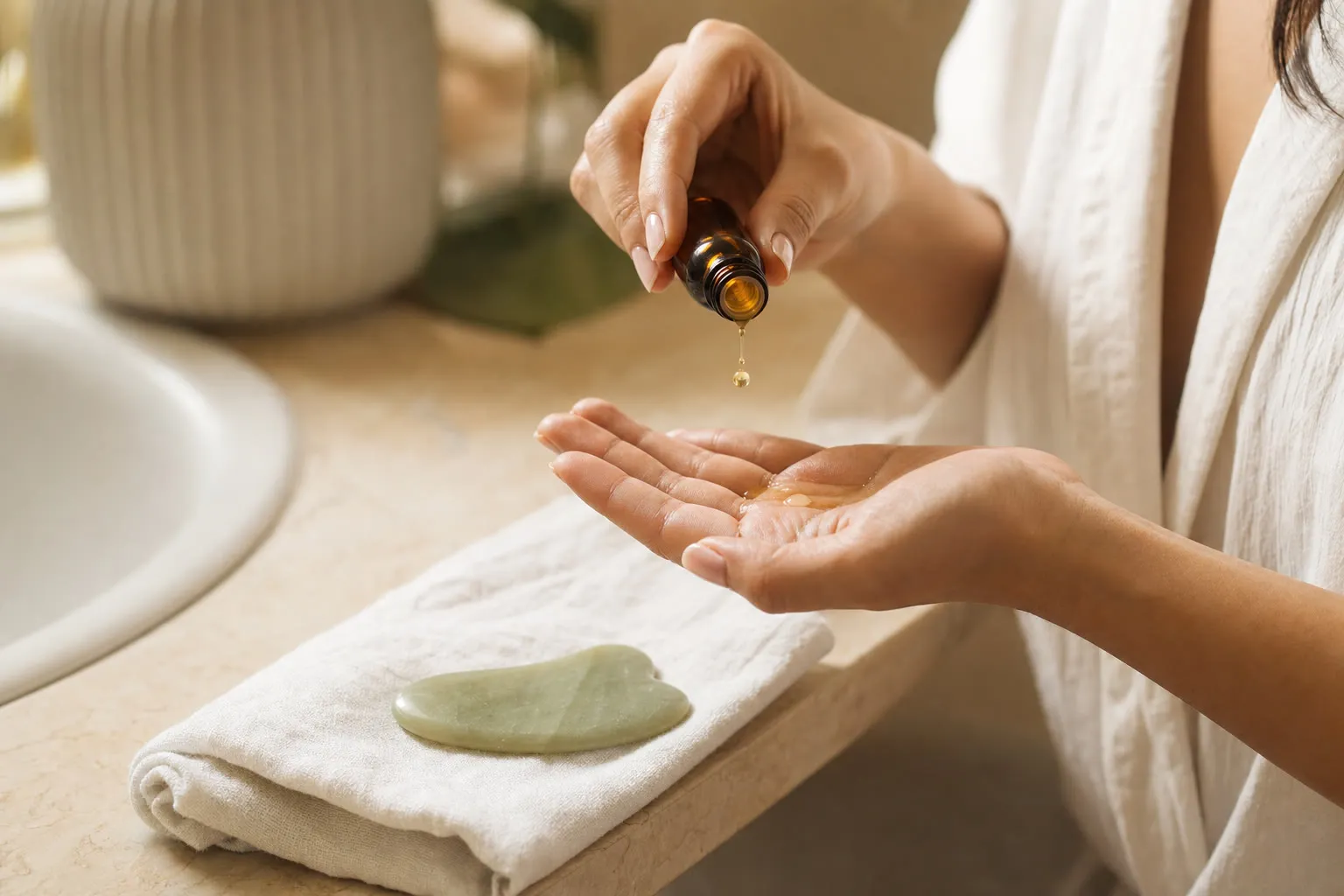
Best oils for lymphatic drainage massage: the carrier oils compared
The base of every massage oil is a carrier oil. This is where the real differences live: how it feels, how fast it absorbs, whether it clogs pores, and what it costs.
| Carrier oil | Feel and absorption | Face-safe? | Comedogenic rating* | Price per 100 ml | Best for |
|---|---|---|---|---|---|
| Jojoba | Light, close to skin's own sebum; absorbs in minutes | Yes, including acne-prone | 2 (low) | $8–15 | Face and neck; gua sha; everyday |
| Grapeseed | Very light, dry finish, cheap | Yes | 1 (very low) | $4–8 | Face, neck, arms; oily or acne-prone skin |
| Sweet almond | Medium, silky, lasts through a longer session | Usually; can clog for some | 2 | $5–10 | Legs, stomach, arms; body sessions |
| Fractionated coconut (MCT) | Light, stays liquid, non-greasy | Yes | 2–3 | $6–12 | Body; blending with essential oils |
| Virgin coconut | Heavy, solid below 24 °C, long-lasting | Not for acne-prone faces | 4 (high) | $5–10 | Legs and feet only |
| Squalane | Very light, no scent, no residue | Yes, the gentlest option | 0–1 | $12–25 | Sensitive or reactive face skin |
| Sunflower / safflower (high-linoleic) | Light, inexpensive | Yes | 0–1 | $3–6 | Body; budget option |
| Olive | Heavy, slow to absorb, strong scent | Avoid on the face | 2 | $4–8 | Legs if it is what you have |
| Mineral oil / baby oil | Very slippery, sits on the skin | Fine for body; not ideal for face | 0 | $2–5 | Legs; the cheapest slip that works |
| Moisturizer or aloe gel (no oil) | Thin layer, absorbs fast | Yes | Depends on product | — | Face if you dislike oil; quick morning routines |
*Comedogenic ratings are from rabbit-ear and human back tests and are a rough guide, not a rule; an oil rated 2 clogs some people's pores and not others'.
If you want one bottle for everything, jojoba is the usual answer: light, stable for a year or more, fine on the face, and it does not go rancid quickly. If you only work on legs and stomach, sweet almond or fractionated coconut feel nicer for longer strokes and cost less. If your face breaks out easily, grapeseed or squalane, or skip oil altogether (face routine works with bare clean fingers).
Essential oils for lymphatic drainage: what the evidence says
Almost every product sold as a "lymphatic drainage oil" is a carrier oil with a blend of essential oils, most often grapefruit, lemon, juniper berry, cypress, rosemary, ginger, geranium, fennel or lavender. Three honest statements about them:
- None has been shown to move lymph. There are no controlled trials in which an essential oil, applied to the skin, changed lymph flow, limb volume or swelling in healthy people. The mechanism proposed on labels, "stimulating" lymph vessels through the skin, has not been demonstrated (3). Reviews of aromatherapy massage find the massage, not the aroma, accounts for the physical effects, with the scent adding to relaxation and mood (4).
- Some do something else you may like. Lavender and bergamot are consistently linked with lower reported anxiety and better sleep in aromatherapy trials (4); a calm ten minutes with a scent you enjoy is a real benefit, and a good reason to keep doing the routine. Ginger and rosemary produce a mild warming sensation. Peppermint cools. That is comfort, not drainage.
- Several carry real skin risks. Cold-pressed citrus oils (grapefruit, lemon, bergamot, lime) are phototoxic: skin treated with them and then exposed to sun can burn or darken for up to 12–18 hours (5). Cinnamon, clove and oregano are irritants. Any essential oil used neat, or at more than about 1–2% in a carrier (roughly 1–2 drops per teaspoon of carrier), can sensitize skin over time, and the face and neck are the most reactive areas.
So the honest rule: if you enjoy a scent, add 1 drop of lavender, geranium or frankincense to a teaspoon of carrier oil for the body, and use unscented on the face; skip citrus oils before daytime routines, and do not pay more for a "lymphatic blend" than you would for the carrier oil inside it. The same reasoning applies to swallowed products; lymphatic drainage drops and supplements goes through those ingredients one by one, and lymphatic system support ranks what actually moves lymph.
How much oil to use
Less than you expect. Lymph strokes need the skin to move with your fingers, and too much oil makes the fingers slide over the skin instead of stretching it. The working amount:
- Face and neck: 3–5 drops for the whole face, warmed between the palms, pressed on rather than rubbed in. Enough that a gua sha stone glides; little enough that your fingertips still catch the skin slightly.
- Stomach: about half a teaspoon (2–3 ml).
- Each leg: half to one teaspoon; more for a full thigh-to-foot routine.
- Each arm: a quarter to half a teaspoon.
If your hands slide without moving the skin, blot the excess with a tissue and continue. If the skin drags and turns pink, add a drop. Professionals often use very little or none at all for the same reason; the technique is skin stretch, not gliding (professional vs at-home lymphatic drainage).
How to apply lymphatic drainage oil, zone by zone
The order is the same in every zone: warm a few drops in your palms, open the "exit" nodes first with oil-free pumps, then oil the zone and stroke toward those nodes at skin-light pressure. The full routines are on their own pages; here is where the oil goes and where it does not.
- Collarbones and neck (always first). No oil for the collarbone pumps: press the hollow above each collarbone gently ten times with dry fingers. Then 2 drops for the sides of the neck, stroking down from behind the ears to the collarbones. Neck routine.
- Face. 3–5 drops, pressed over the whole face. Strokes go from the centre outward and down: forehead to temples, under-eyes to temples, cheeks to the ears, jaw to the ears, then down the neck. Oil-free if you are acne-prone; a damp face with a thin serum works too. Face routine and eye bags and puffy face.
- Stomach. Half a teaspoon. Clockwise circles around the navel, then strokes from the sides of the waist toward the groin creases. Stomach routine.
- Legs. Open the groin creases with dry hands first (gentle pumps), then oil the thigh and stroke upward toward the groin, then the calf toward the back of the knee, then the foot and ankle toward the calf. Legs routine and swollen ankles.
- Arms. Open the armpit with dry pumps, then oil the upper arm and stroke toward the armpit, then the forearm toward the elbow, then the hand toward the wrist. Arms routine.
Finish with ten slow belly breaths. Wash your hands, and wash any tool you used with mild soap; oil left on a gua sha stone or roller is the usual cause of "my gua sha gave me spots" (gua sha for lymphatic drainage).
Oil with tools: gua sha, rollers, brushes
- Gua sha stone: needs slip. A few drops of jojoba or grapeseed, stone held almost flat, slow strokes toward the nodes. Without oil the stone drags and reddens the skin.
- Face roller: works with or without oil; a thin layer of moisturizer is enough.
- Dry brush: the name says it. Dry brushing is done on dry skin before a shower, no oil, then moisturize afterward. Oiling the skin first defeats the point and clogs the bristles. Dry brushing for lymphatic drainage and the best lymphatic drainage brush.
- Vibration plates, massage guns, compression devices: no oil involved.
When to skip oil entirely
- Acne-prone or reactive face skin. Clean fingers on clean skin move lymph exactly as well; the skin-stretch is what matters. If you want slip, a thin layer of your usual moisturizer or a water-based gel is the low-risk option.
- Quick morning routines. The 5-minute morning face routine is easier to keep up with no bottle involved; morning or night explains why mornings work best for the face.
- Broken skin, rashes, sunburn, active eczema flares. No massage over those areas, with or without oil.
- Right after a chemical peel, retinoid irritation or laser. Wait until the skin has settled.
- You are about to go into the sun. No citrus essential oils in the previous 12 hours; plain carrier oil is fine.
What to expect, and what the oil will not do
A session with the right amount of oil feels smoother and you can stay lighter, which is the point; what changes afterward is the same as with bare hands: a less puffy face within the hour, lighter legs by evening, a trip to the bathroom, and a baseline that shifts over one to three weeks of daily routines (lymphatic drainage before and after, how often to do it). The oil will not make any of that bigger, faster or longer-lasting, will not "flush toxins" (the lymphatic cleanse page explains why that phrase is marketing), and will not change fat or cellulite. If a product's pitch depends on the oil doing the work, the honest answer is on how the lymphatic system works: it moves for muscle, breath and skin stretch, and nothing you can pour.
Safety note
Light self-massage with a plain carrier oil is low-risk for healthy adults. Patch-test any new oil or blend on the inner forearm for 24 hours first. Keep essential oils to 1–2% in a carrier and off the face, avoid cold-pressed citrus oils before sun exposure, and keep all essential oils away from children, pets and pregnancy unless a clinician says otherwise. Do not massage over broken skin, rashes, infection, a warm or painful swelling, or a suspected clot, and ask a clinician before any routine if you have lymphedema, heart, kidney or liver disease that causes swelling, or active cancer under treatment. Mild effects after a session (more urination, thirst, a runny nose after face work) are normal and listed on lymphatic drainage side effects. This page is educational and not medical advice.
FAQ
What oils are best for lymphatic drainage?
Any light carrier oil that lets your fingers glide at skin-light pressure: jojoba for the face and everyday use, grapeseed or squalane if your skin breaks out, sweet almond or fractionated coconut for legs and stomach. The oil is slip; the strokes toward the lymph nodes do the work.
Does lymphatic drainage oil really work?
The massage works; the oil only makes it smoother. No oil or essential-oil blend has been shown to move lymph, reduce swelling or remove anything from the body on its own. What you feel after a session comes from the strokes, breathing and movement you did while applying it.
Which essential oils are good for lymphatic drainage?
None has evidence for lymph flow. Lavender, bergamot and geranium are linked with relaxation and better sleep in aromatherapy trials, which is a real reason to enjoy them at 1 drop per teaspoon of carrier oil on the body. Cold-pressed citrus oils (grapefruit, lemon, bergamot) are phototoxic and should stay off skin that will see sun.
Can I do lymphatic drainage without oil?
Yes, and for the face many people prefer it. Clean, dry fingers on clean skin stretch the skin toward the nodes exactly as well. If your fingers drag, a thin layer of moisturizer or a water-based gel gives enough slip without oil.
How much oil should I use for lymphatic massage?
3–5 drops for the whole face, about half a teaspoon for the stomach, half to one teaspoon per leg. If your hands slide without moving the skin, you have used too much; blot and continue.
Is coconut oil good for lymphatic drainage?
Fractionated (liquid) coconut oil is a good light body oil. Virgin coconut oil is heavy and clogs pores for many people, so keep it to legs and feet and off the face.
What can I drink to unclog my lymphatic system?
Nothing needs unclogging: in a healthy person lymph slows with sitting but does not block. Plain water at a normal amount keeps blood volume steady so the kidneys can release fluid; no tea, juice or drops moves lymph. A walk, ten belly breaths and five minutes of light strokes do.
Can I use lymphatic drainage oil every day?
Yes. A plain carrier oil used daily at these small amounts is fine for most skin. Keep essential oils to occasional, low-dose use on the body, and give reactive skin oil-free days if it starts to feel congested.
Sources
- Földi M, Strössenreuther R. Foundations of Manual Lymph Drainage. 3rd ed. Elsevier Mosby; 2005. (Pressure, direction and skin-stretch principles of manual lymphatic drainage.)
- Tan IC, Maus EA, Rasmussen JC, et al. Assessment of lymphatic contractile function after manual lymphatic drainage using near-infrared fluorescence imaging. Arch Phys Med Rehabil. 2011;92(5):756–764. https://pmc.ncbi.nlm.nih.gov/articles/PMC3128437/
- National Center for Complementary and Integrative Health. Aromatherapy: What You Need To Know. https://www.nccih.nih.gov/health/aromatherapy
- Sánchez-Vidaña DI, Ngai SP, He W, Chow JK, Lau BW, Tsang HW. The effectiveness of aromatherapy for depressive symptoms: a systematic review. Evid Based Complement Alternat Med. 2017;2017:5869315. https://pmc.ncbi.nlm.nih.gov/articles/PMC5241490/
- Tisserand R, Young R. Essential Oil Safety: A Guide for Health Care Professionals. 2nd ed. Churchill Livingstone; 2014. (Phototoxic citrus oils; dermal maximum concentrations.)
- Breslin JW, Yang Y, Scallan JP, Sweat RS, Adderley SP, Murfee WL. Lymphatic vessel network structure and physiology. Compr Physiol. 2018;9(1):207–299. https://pmc.ncbi.nlm.nih.gov/articles/PMC6459625/
Lymph Plan team (Virix Labs). Educational content, not medical advice.