 Lymph Plan
Quick answer: Dry brushing is sweeping a natural-bristle brush over dry skin before you shower, always toward the heart and the nearest lymph nodes, with light pressure, for 3–5 minutes, 3–4 times a week. It reliably exfoliates and gives a temporary flush of circulation; the "lymphatic drainage" effect is plausible (skin stretch moves surface lymph) but not well proven. It is a pleasant, cheap habit that many people keep; it is not a detox and doesn't remove cellulite.
Download the direction chart (printable)
What dry brushing actually does
Three things happen when you brush dry skin: dead skin cells come off (exfoliation), tiny blood vessels near the surface open (the pink flush), and the skin is gently stretched over the lymph vessels just beneath it. The first two are certain. The third is the reason it's tied to lymphatic drainage: surface lymph vessels respond to skin stretch, which is the same principle as manual lymphatic massage, only with a brush. No good studies have measured whether dry brushing meaningfully increases lymph flow in healthy people. Cleveland Clinic's dermatology take is fair: it exfoliates, it can feel invigorating, and claims beyond that are unproven.
So: worth doing for smoother skin, a wake-up and a few minutes of body attention; not a substitute for movement and breathing if puffiness is your goal.
The rules
- Dry skin, dry brush. Before the shower, not in it.
- Toward the heart, toward the nodes. Legs and arms: long strokes upward. Belly: clockwise circles. Chest and back: toward the armpits and collarbones. Never brush outward from the center.
- Light. Pink is the goal; red, scratched or stinging means too hard. Bristles should be firm but not scratchy.
- Skip broken skin, rashes, sunburn, eczema flares, varicose veins that hurt, and the face unless you use a separate, soft facial brush.
- Rinse, moisturize, and wash the brush weekly.
The 5-minute full-body routine
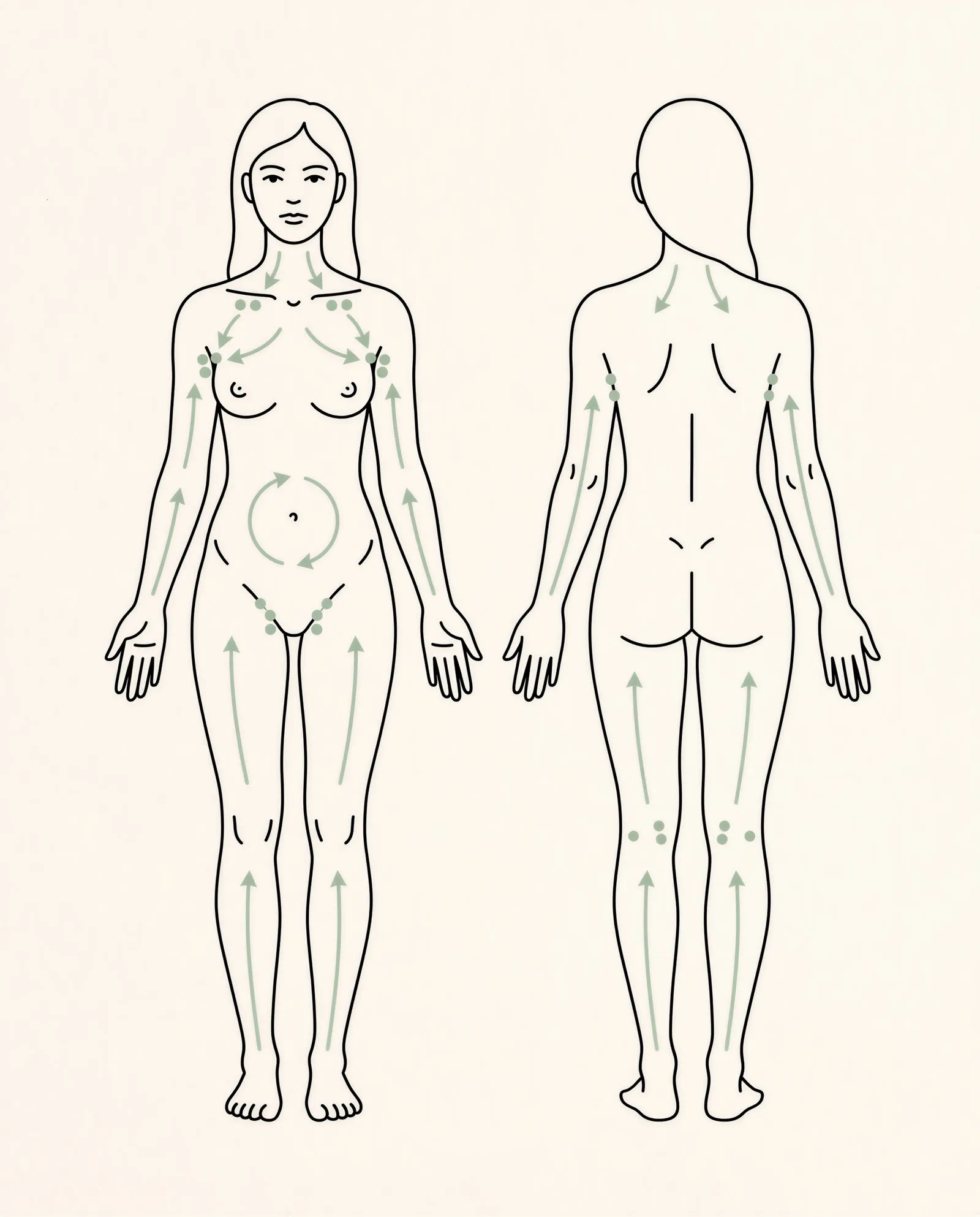
1. Open the drains (30 seconds). With your hand, not the brush: gentle pumps above the collarbones, then in the armpits and groin creases. This gives the fluid somewhere to go.
2. Feet and legs (1.5 minutes). Start at the soles and tops of the feet, sweep up over the ankles, calves, knees and thighs toward the groin. Five to ten strokes per area, front, sides and back. Long strokes on the thighs, ending at the groin crease.
3. Buttocks and lower back (30 seconds). Upward and toward the front of the hips.
4. Belly (30 seconds). Gentle clockwise circles around the navel, then strokes from the sides toward the center and down toward the groin.
5. Hands and arms (1 minute). From the fingers up over the wrists, forearms and upper arms toward the armpit. Then a few strokes from the shoulder down into the armpit.
6. Chest and upper back (30 seconds). From the center of the chest outward toward the armpits, above the breast tissue. Reach over the shoulder and brush the upper back toward the armpit.
7. Neck (30 seconds). Very light, downward strokes from the jaw to the collarbones. Many people prefer hands here; the skin is thin.
Shower, then moisturize. Total 3–5 minutes.
How often and for how long
Three to four times a week is plenty; daily is fine if your skin isn't irritated. Each session 3–5 minutes. Longer isn't better; harder is worse. Morning suits most people because of the wake-up effect.
Choosing a brush
Natural bristles (sisal, boar, cactus/tampico) of medium firmness, a long handle for the back, and a strap or short handle for control on the legs. Soft brushes for sensitive skin; separate, softer brushes for the face. Synthetic bristles work too if they're not sharp. Price makes little difference. Our comparison of body and face brushes is in Lymphatic drainage tools.
Dry brushing the face
The face has its own small brushes and its own rules: much softer bristles, lighter pressure, and the same downward-and-outward direction as facial lymphatic massage (center to ears, then down the neck). Many people get more from hands or a gua sha than a brush. If you want the routine, see Lymphatic drainage for the face and apply the brush version of those strokes 2–3 times a week.
What to expect
Right away: pink, warm, tingling skin; a wake-up feeling; sometimes the urge to pee. Within two weeks: noticeably smoother skin, especially on legs and arms. Puffiness: some people notice less morning heaviness when they combine brushing with breathing and movement; brushing alone rarely changes much. Cellulite: no. It's a structural fat-and-connective-tissue pattern; brushing can temporarily plump the skin's surface, nothing more.
Downsides and who should skip it
Irritation, tiny scratches or a flare of eczema or psoriasis if you press hard or brush inflamed skin. People with very sensitive skin, open wounds, active infections, sunburn, or on medications that thin the skin should skip it. If you have lymphedema or are in cancer treatment, ask your therapist before adding any lymph technique. Feeling "weird" (lightheaded, tingly) after brushing is usually the circulation flush plus standing in a warm bathroom; sit down, drink water, and brush more lightly next time.
FAQ
Does dry brushing help with lymphatic drainage?
Possibly, at the skin's surface; it isn't well proven. It reliably exfoliates and boosts surface circulation. For real fluid movement, pair it with breathing, walking and self-massage.
How long should I dry brush?
Three to five minutes per session, three to four times a week.
How do you open lymph nodes for dry brushing?
Gentle hand pumps above the collarbones, in the armpits and groin before you start, so fluid has an exit.
Which direction do you dry brush?
Toward the heart: up the legs and arms, clockwise on the belly, toward the armpits on the chest and back, down the neck.
Why do I feel weird after dry brushing?
Surface blood vessels open and you may be standing in a warm room; mild lightheadedness passes. Brush lighter and shorter.
Should I dry brush before or after a shower?
Before, on dry skin, then shower and moisturize.
Can I dry brush my face?
Only with a soft facial brush and light pressure, downward and outward. Hands or gua sha are often better.
Does dry brushing get rid of cellulite?
No. It can temporarily smooth the skin's look for an hour or two.
Sources
- Cleveland Clinic. The truth about dry brushing and what it does for you (dermatology).
- GoodRx Health. Dry brushing: techniques and use for lymphatic drainage.
- Moore JE, Bertram CD. Lymphatic system flows. Annu Rev Fluid Mech. 2018.
- Vairo GL et al. Systematic review of efficacy for manual lymphatic drainage techniques. J Man Manip Ther. 2009.
Lymph Plan team. Wellness information, not medical advice.