 Lymph Plan
Quick answer: The Big 6 is a 5-minute self-care routine, popularized by chiropractor Dr. Perry Nickelston of Stop Chasing Pain, that gently rubs, taps and moves six lymph-node areas in a fixed order: above the collarbones, the sides of the neck, the armpits, the belly, the groin creases and the backs of the knees. The idea is to open the "drains" before any massage, exercise or dry brushing, so fluid you move afterward has somewhere to go. It uses light pressure, about 10–20 slow circles per spot, daily, on its own or as the first minutes of a longer routine.
Build my lymph plan → quiz
What the Big 6 is, and where it comes from
Lymph is the clear fluid that leaks out of your capillaries all day. Thin vessels collect it, pass it through clusters of nodes, and return it to the bloodstream through two ducts that empty into the veins above your collarbones. Lymph has no pump: it moves when muscles contract, when the diaphragm moves with deep breathing, and when the skin over the vessels is gently stretched.
Dr. Perry Nickelston, a chiropractor who teaches under the Stop Chasing Pain name, built the Big 6 around one principle from clinical manual lymphatic drainage: work the drain first, then the area. Vodder- and Földi-style therapy begins every session at the collarbones and works from the trunk outward, so fluid moved from the periphery meets open node groups on its way back. Nickelston stripped that down to six stops anyone can find on their own body.
Two honest caveats. The Big 6 is a wellness routine, not a treatment; the research on manual lymphatic drainage is mostly about medical swelling after surgery. And "reset" is a big word for something modest: a few minutes of skin stretch, tapping and movement, and the way you feel for the next few hours. Still worth five minutes to most people who wake up puffy or sit all day.
The six points, in order
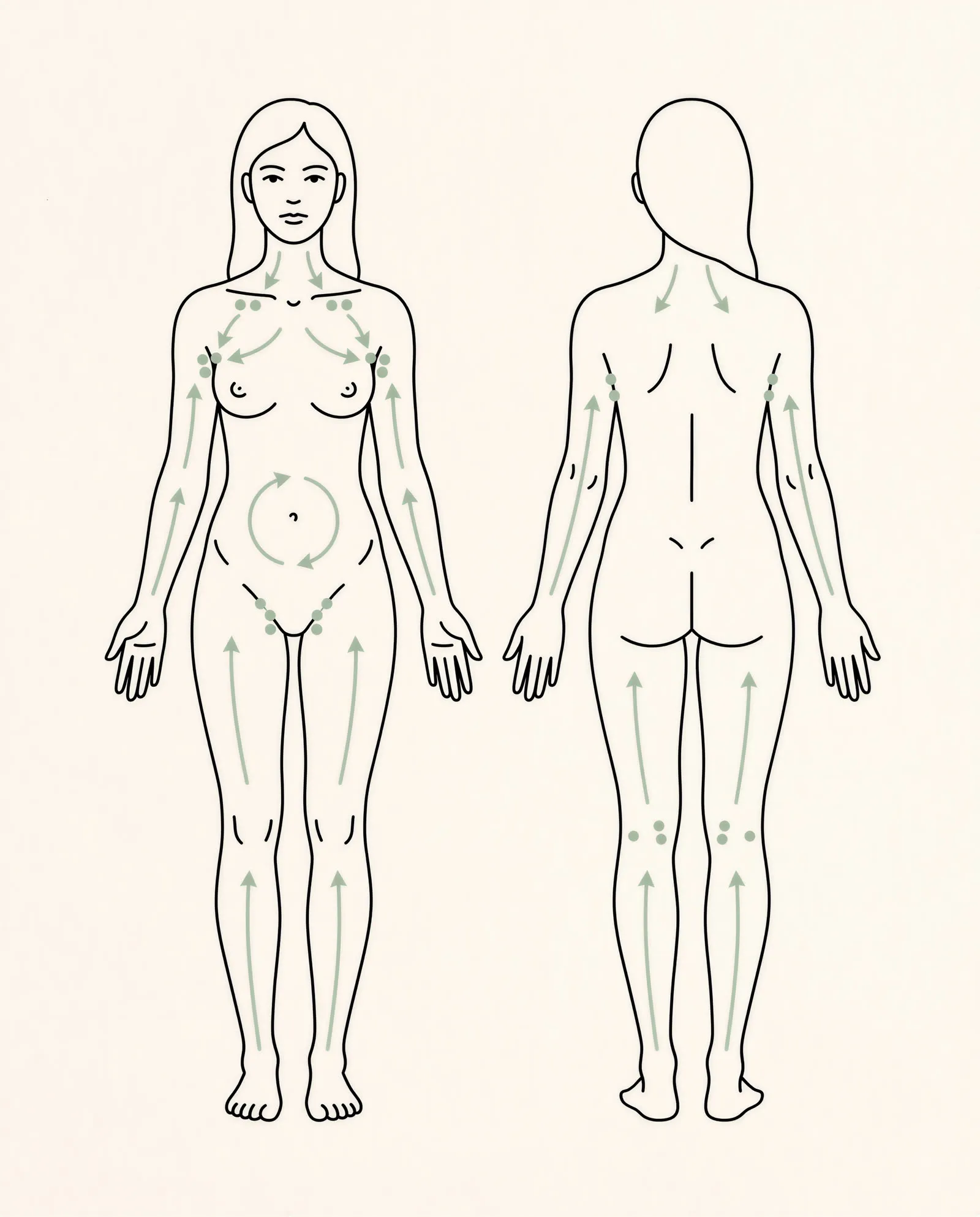
| # | Where | What drains there | How to find it |
|---|---|---|---|
| 1 | Above the collarbones (the terminus) | Everything: both large lymph ducts empty into the veins here | The soft hollow just above each collarbone, beside the base of the neck |
| 2 | Sides of the neck and under the jaw | Head, face, sinuses, scalp, ears | From under the earlobe down the side of the neck to the collarbone |
| 3 | Armpits | Arms, chest, upper back, breast tissue | The hollow of the armpit and the front fold where the pec meets the arm |
| 4 | Belly, around the navel | Gut and lower trunk; deep vessels pass here toward the main duct | Two to three fingers around the navel, and the soft area under the ribs |
| 5 | Groin creases | Legs, lower belly, buttocks | The fold where the thigh meets the pelvis |
| 6 | Backs of the knees | Lower legs, feet | The soft hollow behind each knee |
The order runs top down because the drain is at the top, the same sequence a trained lymphatic therapist uses, just faster and lighter.
The 5-minute routine: rub, tap, move
Stand or sit upright, shoulders relaxed, clean hands, no oil. At each stop: slow circles, light taps, a movement of the nearby joint. Pressure light enough to move the skin and nothing underneath; pink skin means too hard.
0. Three breaths (20 seconds). Hands on the lower ribs, slow breaths that widen the ribs and drop into the belly. The diaphragm is the biggest lymph pump you have.
1. Collarbones (45 seconds). Fingertips in the hollow above each collarbone. 10–20 slow circles, 10 light taps, five slow backward shoulder rolls. This is the drain; nothing else works well until it is open.
2. Neck (45 seconds). Flat hands under the ears, 10–20 light downward strokes to the collarbones, taps along the side of the neck, then turn the head side to side and nod, five times each. Full version on the neck and sinus page.
3. Armpits (45 seconds). Hand flat in the opposite armpit, 10–20 slow circles, taps, five big arm circles each way. Both sides (arms page).
4. Belly (45 seconds). Both hands flat around the navel, 10–20 slow clockwise circles, a gentle press-and-release under the ribs with the breath, five slow torso twists. Detailed version: lymphatic drainage for the stomach.
5. Groin (45 seconds). Hands flat in the creases where the thighs meet the pelvis, 10–20 slow circles, taps, five hip circles or 20 seconds marching in place.
6. Backs of the knees (45 seconds). Hands cupped behind the knees, 10–20 slow circles, taps, 10 slow calf raises or knee bends (legs page).
Finish (20 seconds). Three slow breaths and 10 collarbone pumps to send whatever you moved into the drain.
Total: 5–6 minutes. If you only have two, do breaths, collarbones and neck; that is the part that makes any later face or body work count.
Why the order matters
Fluid from your legs, belly, arms and face all funnels to the same two exits above the collarbones. If those are the last things you touch, you have spent five minutes pushing fluid toward a closed door, which is the biggest reason people say lymphatic self-massage "did nothing." The Big 6 makes the drain the whole routine. Do it, then the face routine if you woke up puffy, the full-body self-massage, dry brushing before a shower, or nothing at all on a busy day.
Big 6 vs. full self-massage vs. dry brushing vs. walking
| Method | Time | What it mainly does | Best for |
|---|---|---|---|
| Big 6 reset | 5 min | Opens the node areas top-down with skin stretch, tapping and joint movement | Daily opener; days with no time for anything else |
| Full-body self-massage | 10–20 min | Moves fluid from each zone toward its nodes with directional strokes | Puffy face, tight belly, heavy legs; evenings |
| Dry brushing | 3–5 min | Skin stretch with a brush in the same direction, before a shower | People who like a tool and a ritual; body zones |
| Walking, rebounding, breathing | 10–30 min | Muscle and diaphragm pumping, the strongest movers of lymph | Everyone; the base the rest sits on |
They stack: movement does most of the work, the Big 6 opens the drains, massage or brushing targets the zone you care about. Lymphatic walking, rebounding and exercises cover movement; tools compares brushes, gua sha and rollers.
How often, when, and what to expect
Daily is fine. Light pressure, once a day; three times adds nothing. Morning suits a puffy face, evening a heavy body after sitting. How often has the weekly schedule by zone.
What you feel. Within minutes: a lighter neck and face, sometimes a runny nose, a gurgling belly or the urge to pee. That is fluid moving, and it is the whole effect. It lasts hours, not days (how long lymphatic drainage lasts). Over weeks: no anatomical change, but fewer bad mornings.
"I get overstimulated doing this." Shorten it: breaths, collarbones, neck, done. Two minutes, slow strokes, no tapping.
"Can I take drops instead?" No supplement replaces movement, breathing and the position of your body; drops and "lymph" supplements have no good evidence for everyday puffiness.
"Does drinking more water help?" Normal hydration, yes; forcing water, no. Puffiness comes from salt, alcohol, lying flat and sitting still.
Mistakes that make it not work
- Pressing hard. Lymph vessels sit just under the skin and flatten under pressure. The weight of a coin, not a massage.
- Starting at the puffiest spot. Collarbones first, always.
- Skipping the movement step. Circles and taps are the cue; shoulder rolls, twists and calf raises are the pump.
- Holding your breath, or expecting it to cancel a salty dinner, three drinks and five hours of sleep. It helps; it does not override.
Who should skip it or ask a clinician first
This is wellness education for everyday fluid retention, not a treatment, and not a way to "shrink" a swollen node. Never rub or tap over a node that is hot, red, painful or swollen from an infection; those nodes are your immune system working and settle within a couple of weeks. Skip the routine while you have a fever, a skin infection, or a cut or rash over any of the six areas.
Ask a clinician first if you are being treated for cancer, have lymphedema, recent surgery or radiation in any of the six areas, a heart, kidney or liver condition that causes swelling, a history of blood clots, or are pregnant. See a doctor promptly for a lump that is hard, fixed, painless and growing; node swelling lasting more than 2–3 weeks; one-sided, warm or painful swelling, especially in a calf; or swelling with night sweats, weight loss or fever. Signs of sluggish lymph covers the difference. If any step hurts, stop; correct drainage never hurts.
Build the rest of your plan
The Big 6 is the opener. The rest depends on where fluid shows for you: face in the morning, stomach by evening, legs after sitting. Take the 2-minute quiz and get a routine built around your zones and the minutes you have.
Build my lymph plan → quiz
FAQ
How often should I do the Big 6 lymphatic drainage?
Once a day, at whatever time you will keep. Light pressure means daily is safe; more than once a day adds nothing. On days you also do a full-body routine, do the Big 6 first.
What are Dr. Perry's Big 6 points for lymph flow?
In order: the hollows above the collarbones, the sides of the neck, the armpits, the belly around the navel, the groin creases, and the backs of the knees. Each gets slow circles, light taps and a movement of the nearby joint, starting at the collarbones.
Do you poop a lot after lymphatic drainage?
Some people do, and more people pee more. The belly strokes stimulate the gut, and fluid returning to the blood is cleared by the kidneys. Both are normal and short-lived.
Where does the fluid go after the routine?
Into lymph vessels, through the nodes, and back into the bloodstream above your collarbones; the kidneys handle it like any other fluid. Nothing is "flushed out."
What are the worst foods for a clogged lymphatic system?
Healthy lymph does not clog, so there is no list of foods to fear. A very salty dinner and alcohol reliably make the next morning puffier; normal hydration, movement and sleep help.
Does the Big 6 actually work?
For everyday puffiness and stiffness, most people feel lighter within minutes and the effect lasts hours; a real, temporary result. There are no trials of the Big 6 itself, and the research on manual lymphatic drainage is about medical swelling, so treat it as a habit, not a therapy.
How long until I see results as a beginner?
The same day for the feeling; one to two weeks of daily practice before you notice fewer puffy mornings. Start with two minutes (breaths, collarbones, neck) and add the other stops as it becomes a habit.
Sources
- Nickelston P. Stop Chasing Pain: the Big 6 lymphatic reset. https://www.stopchasingpain.com/
- Rupa Health. Podcast episode: Got pain? Use your lymphatic system to fix it, with Dr. Perry Nickelston. https://www.rupahealth.com/post/podcast-episode-got-pain-use-your-lymphatic-system-to-fix-it-with-dr-perry-nickelston
- Földi M, Földi E (eds). Földi's Textbook of Lymphology for Physicians and Lymphedema Therapists. 3rd ed. Elsevier Urban & Fischer, 2012.
- Wittlinger H, Wittlinger D, Wittlinger A, Wittlinger M. Dr. Vodder's Manual Lymph Drainage: A Practical Guide. Thieme, 2011.
- Moore JE, Bertram CD. Lymphatic system flows. Annu Rev Fluid Mech. 2018;50:459–482. https://pmc.ncbi.nlm.nih.gov/articles/PMC6459623/
- Río-González Á, Cerezo-Téllez E, Gala-Guirao C, et al. Effects of different neck manual lymphatic drainage maneuvers on the nervous, cardiovascular, respiratory and musculoskeletal systems in healthy students. J Clin Med. 2020;9(12):4062. https://pmc.ncbi.nlm.nih.gov/articles/PMC7765613/
- Ezzo J, Manheimer E, McNeely ML, et al. Manual lymphatic drainage for lymphedema following breast cancer treatment. Cochrane Database Syst Rev. 2015;(5):CD003475. https://www.cochranelibrary.com/cdsr/doi/10.1002/14651858.CD003475.pub2/full
- Cleveland Clinic. Lymphatic drainage massage. https://my.clevelandclinic.org/health/treatments/21768-lymphatic-drainage-massage
- Hall JE, Hall ME. Guyton and Hall Textbook of Medical Physiology. 14th ed. Elsevier, 2021. Chapter on the microcirculation and lymphatic system: lymph flow, the lymphatic pump, and the role of muscle contraction.
Lymph Plan team (Virix Labs). Wellness information, not medical advice. A lump that is hard, fixed, painless and growing, node swelling lasting more than 2–3 weeks, or one-sided warm or painful swelling needs a doctor, not a routine.