 Lymph Plan
Quick answer: A face that is puffy when you wake up and close to normal by lunch is almost always fluid: lying flat for 7–8 hours lets it pool in the loose skin around the eyes, cheeks and jaw. Fluid puffiness is soft, symmetrical, worst in the first hour and fades once you move. Under-eye bags that look the same at 8 p.m. as at 8 a.m. are usually not fluid (fat pads, skin, allergies), and no massage changes them. For fluid, a 5-minute light routine that starts at the neck, uses ring-finger pressure under the eyes and ends with cold clears most of it before you leave the house.
Build my 5-minute face plan → quiz
The 60-second check: is it fluid?
Before you buy patches or rollers, work out what you are looking at. Four questions do most of the sorting: Does it fade during the day? Is it on both sides? Is it soft and painless? Does it track with last night (salt, alcohol, crying, a blocked nose, short sleep, the days before your period)? Four yeses means fluid.
| What it is | What it looks like | When it is worst | Changes during the day? | What helps |
|---|---|---|---|---|
| Overnight fluid | Soft, symmetrical swelling under the eyes, cheeks, jaw | First hour after waking | Yes, fades by late morning | Sleeping position, less evening salt and alcohol, a light neck-and-face routine, cold |
| Under-eye fat pads | A rounded pouch that casts a shadow, same all day | All day, more with age | No | Not fluid; a dermatologist or oculoplastic clinician can advise |
| Loose or thin skin | Fine crepey folds, a hollow with a dark tint | All day | No | Skin care, sun protection, sleep; not drainage |
| Allergies or irritation | Itchy, watery, pink eyelids, often with sneezing | Seasonal, after dust, pets, new products | Partly | Removing the trigger; an allergy plan with a clinician |
| Medical swelling | Persistent, sometimes one-sided, painful, red, or all over the face | Days or weeks, not mornings | No | A clinician, not a routine |
This page is about the first row.
Why fluid pools in your face overnight
Lymph is the clear fluid that leaks out of your capillaries all day. Thin vessels collect it and, for the face, drain it down through the nodes of the neck to the veins above your collarbones. Lymph has no pump: it moves when muscles contract, when you breathe deeply, and when the skin above the vessels is gently stretched. Gravity helps only while you are upright.
Lie down for eight hours and nothing pumps, so the loosest tissue on your body, the skin around the eyes, fills with what did not get cleared. Ordinary things raise that baseline:
- Salt and alcohol. A salty or boozy dinner makes the body hold water for a day; the face shows it first.
- Sleeping face-down or on one side. Fluid pools on the side that is lowest; side-sleepers often have one heavier under-eye.
- A blocked nose or a cold. Congested sinus tissue drains through the same route as the cheeks.
- Crying, rubbing your eyes, sleeping in makeup. Irritated eyelids swell.
- Your cycle, and short or broken sleep. Clinical sources on under-eye bags list these alongside salt, allergies and sleeping position as the everyday causes.
None of this means your lymphatic system is broken. It is a healthy system that has been lying still for eight hours.
How to depuff your face in the morning: the 5-minute order
The order matters more than the strokes. Fluid from the eyes has to travel down through the neck to leave; go straight for the eye bags and you push it into a closed drain, which is why people say "I tried lymphatic drainage and felt nothing." Open the drain first.
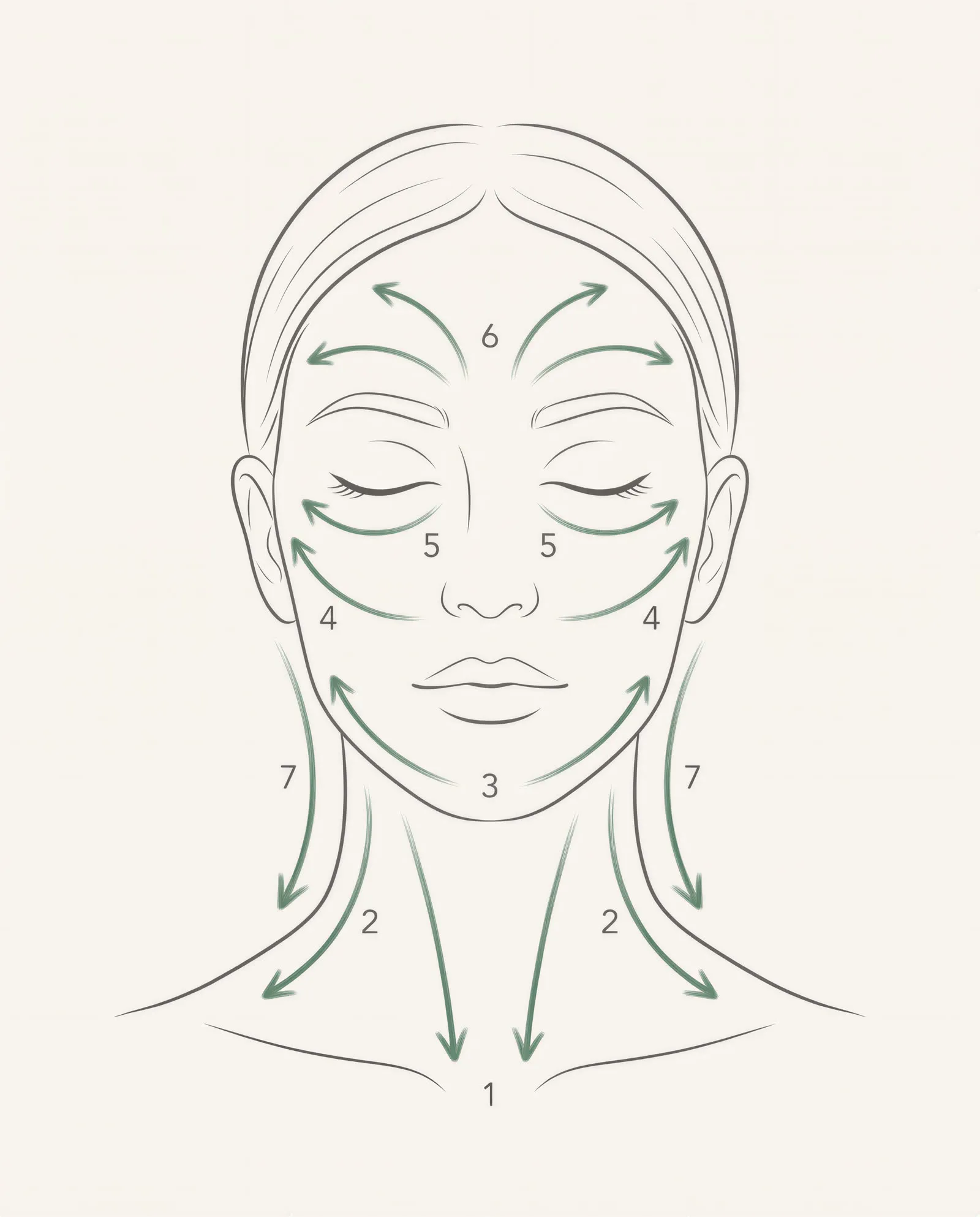
1. Sit up and breathe (30 seconds). Being upright starts the drain. Five slow breaths that widen the ribs; the diaphragm is the largest lymph pump you have.
2. Collarbone hollows (30 seconds). Fingertips in the soft hollow above each collarbone, gentle press-and-release, 10 times. This is where all the fluid from your face ends up.
3. Sides of the neck, downward (30 seconds). Flat hands under the ears, stroke down to the collarbones, 7–10 times each side. Skin moves, muscle does not. Full version on the neck and sinus page.
4. Under-eyes, ring fingers only (60 seconds). From the inner corner under each eye, glide outward along the bone to the temple, then down in front of the ear to the neck, 7–10 times. Lighter than you think: this is the thinnest skin on the face, and pressing hard flattens the vessels you are trying to use. Pink skin means too hard.
5. Cheeks and jaw (60 seconds). Flat fingers beside the nose, sweep across the cheek to the ear and down the neck, 5–7 times. Then chin to ear along the jawline and down, 5–7 times.
6. Cold finish (60 seconds). A cold spoon, chilled roller or cold wet cloth under each eye for 20–30 seconds. Cold narrows the small vessels and tightens tissue for an hour or two; it does not move fluid out, it makes what is left less visible.
7. Collarbones again (20 seconds). Ten last pumps to send everything into the drain.
The full 7-stroke sequence and printable map are on the face routine page.
Dry skin or with serum? Before or after skincare? Either, and before. Clean fingers on clean skin work; a drop of oil helps a gua sha glide. Routine, cold, then serum and moisturizer. If you hate morning shine, do it before washing, then cleanse and carry on.
What makes it worse, and what to change at night
The morning routine handles the fluid that pooled; evening habits decide how much pools.
- Pressure and direction. Rubbing your eyes irritates the lids. A face massage that hurts is a muscle massage. Pushing upward "to lift" sends fluid the wrong way; drainage goes down and out.
- Restricting water does not help; the body holds on harder. Drink normally, cut the evening salt.
- Sleep on your back with your head slightly raised. One extra pillow lets gravity keep working. If you cannot switch, alternate sides.
- Move the salt and the alcohol earlier. A drink at 7 p.m. with water alongside shows less at 7 a.m. than the same drink at 11.
- Take your makeup off, and deal with a stuffy nose (saline rinse, steam) rather than sleeping with blocked sinuses.
- Give it a week. Two of these plus the morning routine usually means fewer bad mornings within 1–2 weeks; realistic expectations are on the before and after page.
How long it lasts, and how often
One session lasts hours, not days: the puffiness returns tomorrow because lying flat happens again. That is why this is a daily morning habit, not a fix. How long lymphatic drainage lasts covers the honest timeline and how often the schedule; morning is right for a puffy face, evening for a heavy face after screens (morning or night). Puffy after a flight? Same routine, longer legs section: after a flight.
When puffiness is not a morning problem
This page is wellness education for ordinary overnight fluid. See a clinician, not a routine, if you have:
- Swelling that lasts all day, every day, for more than two weeks, especially with unusual tiredness, weight change, or skin and hair changes. A doctor can check the common causes with simple tests.
- Puffiness around the eyes together with foamy urine, swollen ankles, or breathlessness lying flat.
- One-sided, painful, red or hot swelling of the face or eyelid, or swelling with fever.
- Sudden swelling of the face, lips or tongue, or trouble breathing. That is an emergency.
- Under-eye bags that never change through the day. Those are structural (fat pads, skin) and a dermatology conversation if they bother you.
If you are being treated for cancer, have a thyroid condition, recent facial or neck surgery, or diagnosed lymphedema, ask your clinician first. If any stroke hurts, stop; correct drainage never hurts.
Build the rest of your plan
The same overnight fluid shows up as a tight belly or heavy legs in others. Signs of sluggish lymph separates everyday fluid from something that needs a check, and the at-home hub has the full-body routine. Or take the 2-minute quiz and get a plan built around your zones and the minutes you have in the morning.
Build my lymph plan → quiz
FAQ
Why is my face very puffy when I wake up?
Because you spent eight hours lying flat with nothing pumping fluid out of the loosest tissue on your body. Salt, alcohol, a blocked nose, crying, short sleep and the days before a period add to it. If it fades by late morning, it is fluid and normal.
How do I depuff my face fast?
Sit up, breathe deeply, open the collarbone hollows, stroke down the sides of the neck, then ring-finger strokes outward under the eyes and across the cheeks, and finish with cold for 30 seconds a side. About 5 minutes. Neck first is the part most people skip.
What deficiency causes a puffy face?
No common vitamin or mineral deficiency causes everyday morning puffiness, and supplements will not remove it. If you have all-day swelling with tiredness or weight change, a clinician can check the usual causes with a blood test rather than guessing.
What does "cortisol face" look like, and how do I flush cortisol?
"Cortisol face" is a social-media label, not a diagnosis. Stress, poor sleep, salt and alcohol can make a face look rounder and puffier; the fix is sleep, movement and the habits above, not a "flush." A face that becomes noticeably rounder over months is something to raise with a doctor.
Does magnesium reduce a puffy face?
There is no good evidence that magnesium supplements reduce morning puffiness in healthy people. Some people find magnesium helps them sleep, and better sleep helps the face; that is an indirect route, not a de-puffing effect.
Does drinking more water make puffiness better or worse?
Normal hydration helps; restricting water does not. A puffy face is not from drinking too much water, it is from salt, alcohol, position and lying flat.
Should I do the routine on a dry face or with serum?
Either. Bare clean fingers are enough; a drop of oil helps a gua sha glide. Do it before your skincare on clean skin, then cleanse if you used oil and carry on.
How long does the de-puffing last, and how often should I do it?
Hours, typically through the morning. Once a day, in the morning, is plenty; daily beats occasionally and hard. After a week or two most people wake up puffy less often, because they clear it every day.
Sources
- Mayo Clinic. Bags under eyes: symptoms and causes. https://www.mayoclinic.org/diseases-conditions/bags-under-eyes/symptoms-causes/syc-20369927
- Cleveland Clinic. Facial swelling: causes and treatment. https://my.clevelandclinic.org/health/symptoms/facial-swelling
- Cleveland Clinic. Lymphatic drainage massage. https://my.clevelandclinic.org/health/treatments/21768-lymphatic-drainage-massage
- Moore JE, Bertram CD. Lymphatic system flows. Annu Rev Fluid Mech. 2018;50:459–482. https://pmc.ncbi.nlm.nih.gov/articles/PMC6459623/
- Río-González Á, Cerezo-Téllez E, Gala-Guirao C, et al. Effects of different neck manual lymphatic drainage maneuvers on the nervous, cardiovascular, respiratory and musculoskeletal systems in healthy students. J Clin Med. 2020;9(12):4062. https://pmc.ncbi.nlm.nih.gov/articles/PMC7765613/
- Ezzo J, Manheimer E, McNeely ML, et al. Manual lymphatic drainage for lymphedema following breast cancer treatment. Cochrane Database Syst Rev. 2015;(5):CD003475. https://www.cochranelibrary.com/cdsr/doi/10.1002/14651858.CD003475.pub2/full
- Medical News Today. Puffy face in the morning: causes, treatments, and prevention. https://www.medicalnewstoday.com/articles/puffy-face-in-the-morning
- Földi M, Földi E (eds). Földi's Textbook of Lymphology for Physicians and Lymphedema Therapists. 3rd ed. Elsevier Urban & Fischer, 2012.
Lymph Plan team (Virix Labs). Wellness information, not medical advice. Swelling that lasts all day for more than two weeks, is one-sided, painful or red, or comes with breathing difficulty, needs a clinician, not a routine.