 Lymph Plan
Quick answer: Legs swell by evening because gravity pulls fluid down and the calf muscles, which pump lymph and blood back up, haven't fired enough while you sat or stood. The fix is mechanical: open the groin nodes, stroke from the thigh, then calf, then foot toward the heart with very light pressure, pump the ankles, and finish with legs up the wall for 5 minutes. Do it in the evening or after long sitting; most people feel lighter immediately and see less sock-line swelling within a week. Swelling in one leg, or swelling with pain, warmth, redness or shortness of breath, is not a routine problem: see a clinician.
Build my plan → legs
Why legs swell by evening
The lymph and veins in your legs work against gravity. Every calf contraction squeezes the vessels and one-way valves keep the fluid moving up; when you sit at a desk or stand still at a counter, that pump idles, and fluid collects around the ankles. Heat, salt, alcohol, long flights, the week before a period, and pregnancy all add to it. This everyday swelling is soft, on both sides, worse at night and better in the morning. That pattern is what the routine below is for.
The 5-minute leg routine
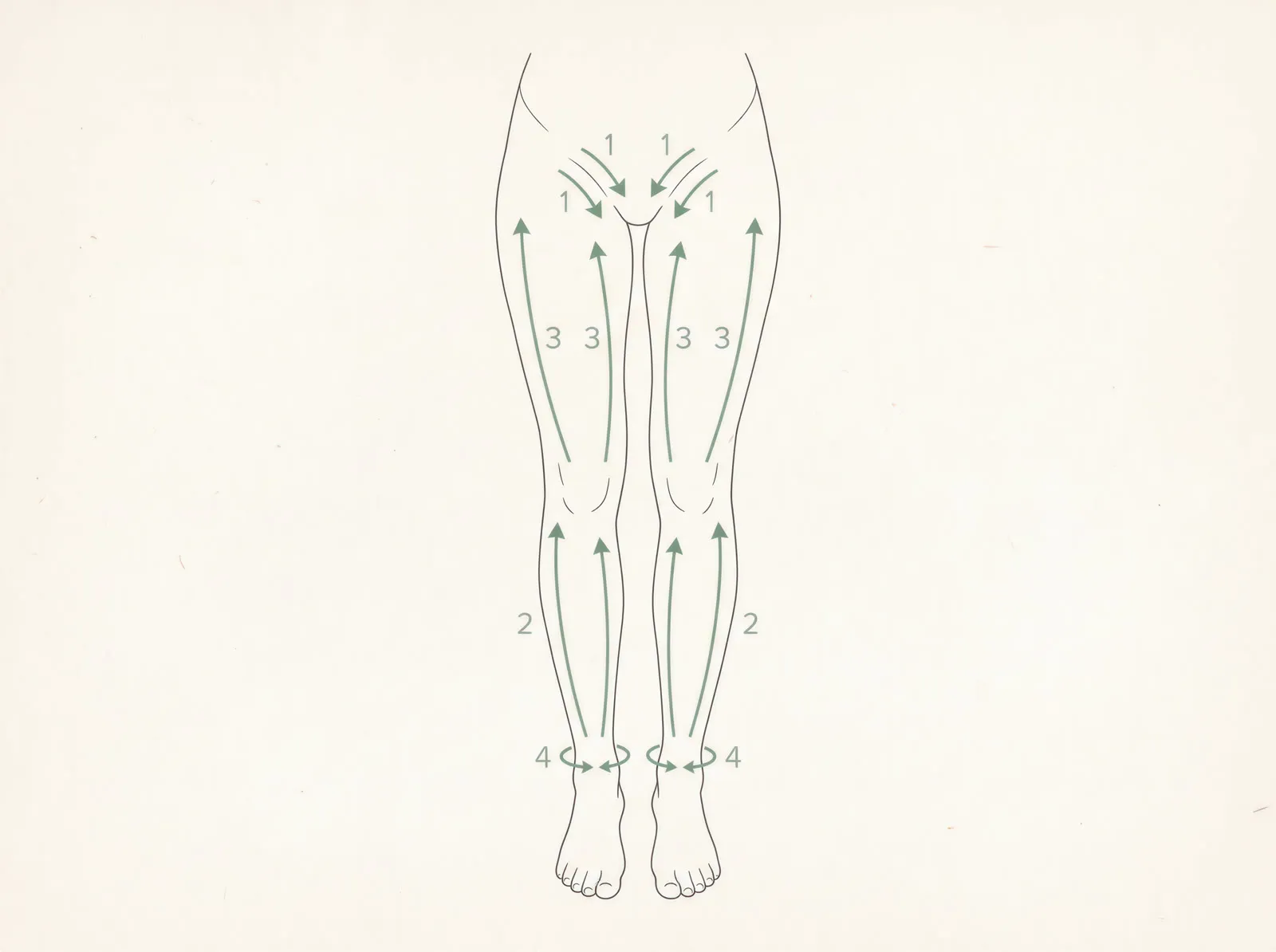
Best position: lying on your back with legs slightly raised on a pillow, or sitting with feet up.
1. Breathe (30 seconds). Five slow belly breaths. The diaphragm pump pulls fluid up from the legs.
2. Open the drains (30 seconds). Gentle pumps above the collarbones (10), then fingertips in the groin creases where the thigh meets the torso, 10 gentle press-and-release pumps each side. The groin nodes are where leg lymph goes first.
3. Thigh (1 minute per leg). Flat hands just above the knee. Stroke up toward the groin along the front, then the outside, then the inside of the thigh, 5–7 strokes each. Light pressure; you're moving skin, not muscle.
4. Knee and calf (1 minute per leg). Gentle circles behind the knee (there are nodes there), 10 times. Then from the ankle up the calf to the back of the knee, 5–7 strokes, front and back of the lower leg.
5. Ankle and foot (30 seconds per leg). Circle the ankle bones gently, then stroke from the toes over the top of the foot to the ankle, and from the sole toward the heel. Finish with 20 ankle pumps (point and flex).
6. Long sweeps (30 seconds). From the foot all the way up to the groin, both legs, 5 times.
7. Legs up the wall (5 minutes, optional but the best part). Lie with your hips near a wall and legs resting up it. Breathe slowly. Gravity does the rest. This pose is also the finish of the 10-minute lymphatic drainage yoga sequence, if you want the whole body warmed up before you get there.
Drink water afterward; expect a bathroom trip.
What helps most, ranked
- The calf pump: walking, ankle pumps, calf raises, rebounding. Ten minutes of any of these beats ten minutes of massage for legs.
- Elevation: legs up the wall or on a pillow above heart level, 5–15 minutes.
- Self-massage as above, especially after standing or flying.
- Compression socks (15–20 mmHg) if you stand, sit or fly for hours. Put them on in the morning before swelling starts.
- The basics: water, less salt, less alcohol, breaks from sitting every 45 minutes, not crossing legs for hours. A vibration plate is a reasonable add-on for people who won't do the first two.
What to expect
Immediately: lighter, tingly legs, less tightness at the ankles. Same evening: sock lines fade faster. After a week or two of daily practice plus movement: ankles noticeably less swollen at day's end. Not going to change: fat distribution or cellulite. See before and after.
Lymphatic drainage legs before and after: what really changes
The before-and-after photos of legs that circulate online are mostly one of three things: a professional session on medical swelling (lymphedema or post-surgery), a photo taken standing at 6 p.m. next to one taken lying down at 8 a.m., or a filter. Here is what a real before and after looks like for everyday evening swelling, hour by hour:
- Before: ankles soft and puffy on both sides, sock or shoe lines, a tight or heavy feeling in the calves, skin that springs back slowly when pressed.
- During the routine (5 minutes): tingling, warmth, sometimes a fluttery feeling behind the knees. Legs feel heavier for a minute, then lighter.
- Right after, plus 5 minutes legs up the wall: the sock lines are shallower, the ankle bones are more visible, calves feel loose. You will need to pee within the hour; that is the fluid leaving.
- 1–3 hours: the best the legs will look that day. This is when the honest "after" photo is taken.
- Next morning: near baseline, but most people wake with lighter legs than usual and the swelling comes back slower the following evening.
- After 1–2 weeks daily, plus walking: the noticeable change. Ankles at 6 p.m. look closer to ankles at 8 a.m.; sock marks are faint or gone on ordinary days; the calves feel lighter by default, not only after a session.
What the photos do not show: fat, cellulite, calf size or leg shape. Fluid is the only thing that moves. If a "before and after" shows a thinner leg, the difference is fluid, camera angle, standing versus lying, or a different time of day. Compression stockings, ten minutes with legs up, or a 20-minute walk produce the same after photo, which tells you what is actually doing the work.
How to take a fair before-and-after of your legs: same spot, same light, same time (evening, after your usual day), feet flat, phone at knee height, no socks for the previous hour. One photo before the routine, one 30 minutes after legs up the wall, and one the next evening before the routine. The 30-minute photo shows the session; the next-evening series over a week shows whether the habit is changing your baseline. The plan includes a 7-day log for exactly this. Before and after covers the same question for the face and belly, and how long lymphatic drainage lasts explains the fading.
Lymphatic drainage leg exercises: the calf pump
Movement moves more lymph out of the legs than any stroke, because every calf contraction squeezes the deep vessels and the valves only let fluid go one way. If you do one thing for heavy legs, do these:
- Ankle pumps, 20–30 each foot. Point and flex, slowly. At a desk, on a flight, in bed before standing up in the morning.
- Calf raises, 15–20. Standing, hold the counter, rise onto the toes, lower slowly. This is the pump at full strength.
- Seated march, 1 minute. Knees up alternately; works the groin nodes as the thigh moves.
- Legs up the wall, 5–10 minutes. Not an exercise, but the pairing that turns the pumps into visible results: pump first, elevate after.
- A 20-minute walk, arms swinging, most days. Lymphatic walking is the technique, with leg-specific tweaks; rebounding is the indoor version.
Do the exercises before the strokes, not after: a warmed-up calf pump plus opened groin nodes is when the routine moves the most fluid. The 10-minute exercise routine has the full-body version.
Lymphatic drainage massage for legs: at home vs a professional session
A professional leg session (30–60 minutes, whole limb, trained MLD technique) moves more fluid on the day and is the right choice for medical swelling, after surgery, or when a therapist is teaching you the home version. For the everyday kind, the 5-minute evening routine done daily beats a monthly appointment, because the fluid comes back every day. Professional MLD on legs should feel like almost nothing: no pressure, no pain, no marks. Deep-tissue leg massage, "sculpting" and hard rollers are not lymphatic drainage, and soreness or bruising the next day is a sign the wrong technique was used (what is and is not a normal side effect). The costs and how to choose a therapist are on treatment: professional vs at home; compression boots and other leg devices are rated on the tools page.
Red flags: when leg swelling is not a lymph routine problem
Not sure whether your evening puffiness is the everyday kind? Swollen ankles and legs: lymph, edema or something else has the thumb-press test and the full red-flag list.
Stop and see a clinician promptly if you have:
- Swelling in one leg only, especially with pain, warmth, redness or tenderness in the calf (possible blood clot; this can be an emergency).
- Swelling with shortness of breath, chest pain, or rapid weight gain (heart, kidney or liver causes).
- Pitting swelling that leaves a dent, or swelling that doesn't go down overnight.
- Swelling after cancer treatment, surgery or radiation in that leg (possible lymphedema; needs a certified lymphedema therapist and compression, not a DIY routine).
- Skin changes, ulcers, or swelling with fever. Medications (some blood pressure drugs, hormones, NSAIDs) also cause leg swelling; ask your prescriber.
Evenings are the legs' time: after a day upright the calves hold the most fluid — see morning or night and how often.
Just landed? The 10-minute version for swollen ankles and a puffy face is in lymphatic drainage after a flight.
FAQ
How do you drain the lymphatic system in your legs?
Open the groin nodes, then light strokes from thigh to calf to foot toward the heart, ankle pumps, and legs up the wall. Add walking daily.
Does lymphatic drainage on legs work?
For everyday evening swelling and heaviness, yes, temporarily and best combined with movement and elevation. For medical swelling, it's part of professional care.
Is lymphatic drainage for legs good for cellulite?
It can make skin look smoother for an hour or two. It doesn't change cellulite.
How often should I do it?
Daily in the evening, or whenever legs feel heavy. Compression and walking on top.
What exercise is best for leg lymph?
Anything that works the calves: walking, ankle pumps, calf raises, gentle bouncing.
Can I do it during pregnancy?
Gentle strokes and elevation are commonly recommended, but check with your clinician, and never ignore sudden or one-sided swelling.
Should I massage up or down?
Up, toward the groin and the heart. Always.
What does lymphatic drainage on the legs look like before and after?
Before: soft puffy ankles, sock lines, heavy calves. After a 5-minute routine and legs up the wall: shallower sock lines, ankle bones visible, calves loose, and a bathroom trip within the hour. Over one to two weeks of daily practice plus walking, evening ankles look closer to morning ankles. Fat, cellulite and leg shape do not change.
How long does lymphatic drainage of the legs last?
A single session keeps legs lighter for a few hours to the rest of the evening; by the next morning you are near baseline. Done daily with walking and elevation, the baseline itself shifts within a week or two, so legs swell less by default.
Can lymphatic drainage make your legs slimmer?
Only by the amount of fluid that was sitting in them, which is real but temporary and usually a few millimetres at the ankle. It does not reduce fat or change calf size. Photos that show a thinner leg after one session are fluid, angle or time of day.
Do lymphatic drainage leggings work?
Compression leggings and socks (15–20 mmHg) do help, by squeezing the leg so fluid cannot pool; that is the same mechanism clinics use for medical swelling. "Lymphatic" leggings without a stated compression grade are ordinary leggings. Put compression on in the morning before swelling starts.
How do I do lymphatic drainage on my legs at home?
Lie with legs slightly raised, five belly breaths, ten collarbone pumps, ten groin pumps each side, then light strokes from thigh to groin, knee to groin, ankle to knee and foot to ankle, five to seven each, and finish with ankle pumps and five minutes legs up the wall. The step-by-step version with the map is above.
Sources
- University Health Network (Toronto). How to do self lymphatic massage on your lower body (patient education).
- Memorial Sloan Kettering Cancer Center. Exercises for lymph drainage: legs and lower body.
- Ezzo J et al. Manual lymphatic drainage for lymphedema following breast cancer treatment. Cochrane Database Syst Rev. 2015.
- Mayo Clinic. Leg swelling: causes; Lymphedema: symptoms and causes.
Lymph Plan team. Wellness information, not medical advice. One-sided, painful or sudden leg swelling needs urgent medical attention.