 Lymph Plan
Quick answer: The lymphatic system is a one-way drainage network that runs alongside your blood vessels. Every day it collects roughly 2–4 litres of fluid that leaks out of your capillaries, filters it through about 600 lymph nodes, and returns it to the bloodstream at the collarbones. It has three jobs: fluid balance, immune defence, and absorbing fat from food. Unlike blood, lymph has no heart to pump it; it moves when you breathe, walk and contract muscles. That one fact explains why you wake up puffy after a still night and feel lighter after a walk.
Which zones puff up for you? → your zones → your 5-minute plan
What the lymphatic system does (three jobs)
1. Fluid balance. Blood pressure pushes plasma out of your capillaries into the tissues all day. Most of it is reabsorbed, but a few litres are left behind. The lymphatic system is the return pipe: it picks up that fluid (now called lymph), along with proteins and cell debris, and carries it back to the veins. If the return pipe slows down, fluid sits in the tissues and you see it as puffiness. If it fails for medical reasons, that is lymphedema, a different thing entirely.
2. Immune defence. Lymph nodes are checkpoints. Lymph passing through is scanned by immune cells; anything foreign (bacteria, viruses, damaged cells) is trapped and dealt with there. That is why a node in your neck swells when you have a sore throat: it is working, not "clogged".
3. Fat absorption. Tiny lymphatic vessels in the gut lining, called lacteals, absorb dietary fat and fat-soluble vitamins (A, D, E, K). After a fatty meal, gut lymph turns milky white. It is the only route these nutrients have into the body.
The lymphatic system is part of the circulatory system in the sense that it moves fluid, and part of the immune system in the sense that it houses immune cells. Both descriptions are correct; it is the bridge between them.
The parts, in plain English
| Part | What it is | What it does |
|---|---|---|
| Lymphatic capillaries | Blind-ended micro-vessels in nearly every tissue | Collect leaked fluid; their walls have flap valves that open when tissue pressure rises |
| Lymphatic vessels | Larger tubes with one-way valves | Carry lymph toward the nodes and then toward the chest; each valve-to-valve segment (a lymphangion) squeezes on its own |
| Lymph nodes (about 600) | Bean-sized filters, clustered in the neck, armpits, chest, abdomen and groin | Filter lymph, hold immune cells, swell when fighting infection |
| Thoracic duct and right lymphatic duct | The two final collecting trunks | Empty lymph into the veins just behind the collarbones |
| Spleen | Fist-sized organ under the left ribs | Filters blood (not lymph), recycles old red cells, stores immune cells |
| Thymus | Small gland behind the breastbone | Trains T-cells, most active in childhood |
| Tonsils and adenoids | Lymphoid tissue at the throat and nose | First checkpoints for what you breathe and swallow |
| Bone marrow | Inside the long bones | Makes the white blood cells the system uses |
| MALT and Peyer's patches | Lymphoid tissue in the gut and airway lining | Immune surveillance where the outside world touches the inside |
So when someone asks "what are 5 organs of the lymphatic system", the usual list is: lymph nodes, spleen, thymus, tonsils, and bone marrow (with the vessels and gut lymphoid tissue as the rest of the network).
A simple diagram: where your nodes are
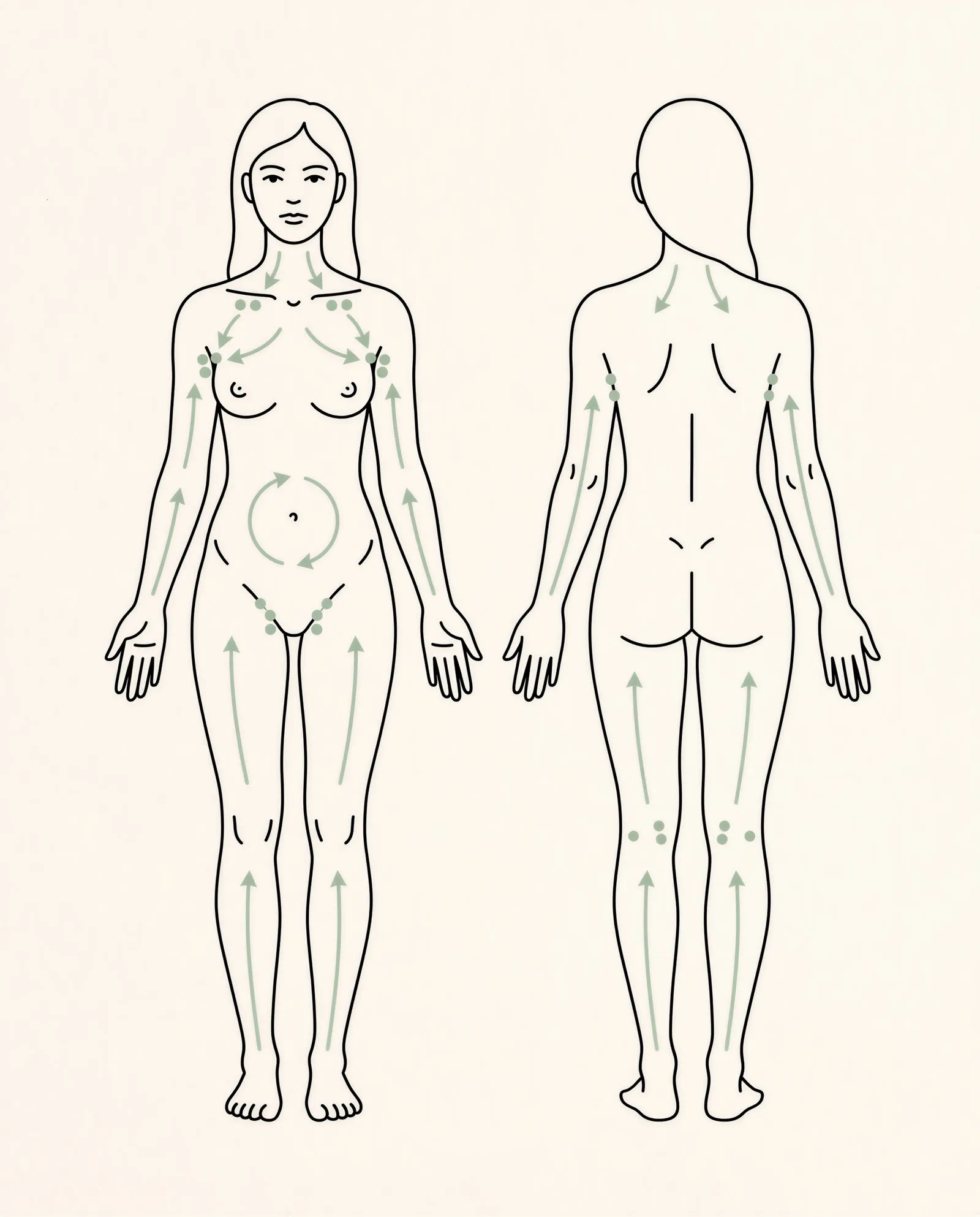
Think of the body as a set of drainage regions, each emptying toward its nearest node cluster and, eventually, toward the collarbones:
- Collarbones (terminus). Where the whole system empties into the veins. Every self-massage routine starts here for a reason: you open the exit before you push anything toward it.
- Neck. Drains the face, scalp, sinuses and throat. Around a third of all your nodes are in the head and neck.
- Armpits. Drain the arms, upper chest and upper back.
- Abdomen (cisterna chyli). Deep behind the belly, the collecting chamber for gut and leg lymph; belly breathing squeezes it.
- Groin. Drains the legs, lower belly and buttocks.
- Behind the knees. Drains the lower legs and feet.
Direction matters more than technique: fluid from the legs travels up through the groin and abdomen; fluid from the face travels down the neck to the collarbones. The "Big 6" routine is simply these six clusters opened in order, and the full-body guide applies the same map with your hands.
Why lymph has no pump (and why that matters to you)
Blood has the heart. Lymph has nothing central. Research summarised in the Annual Review of Fluid Mechanics describes how lymph moves instead:
- Intrinsic contractions. Each lymphangion contracts on its own a few times a minute, pushing fluid past the next valve. This is slow and easily overwhelmed.
- The diaphragm. Every deep breath changes pressure in the chest and abdomen, drawing lymph up from the belly and legs. Shallow chest breathing barely does this.
- Muscle pumps. Calf, thigh and arm muscles squeeze the vessels running through them. Walking is the single biggest lymph pump you own.
- Arterial pulse and body movement. Vessels lying next to arteries get a small squeeze with each heartbeat; any movement helps.
Now apply that to a normal day. Eight hours lying still, then eight hours sitting: the calf pump is off, breathing is shallow, and gravity pools fluid in the face overnight and the legs by evening. That is the whole story behind morning puffiness, evening bloating and heavy legs. It is not toxins, and it is not a broken system. It is a system that was designed to be moved and wasn't.
Flow also drops for physical reasons: dehydration thickens lymph, salt and alcohol increase fluid leaving the capillaries, tight waistbands and bra bands compress surface vessels, and excess body fat impairs lymphatic function (exercise training improves it, as shown in J Physiol 2016).
What keeps the lymphatic system moving
In order of how much they matter, with the evidence honestly stated:
| Habit | Why it works | Evidence level |
|---|---|---|
| Daily walking, 20–30 min | Calf and thigh pumps plus deeper breathing | Strong for fluid clearance; the basis of lymphedema care |
| Belly breathing, 5 min | Diaphragm draws lymph up from the abdomen | Well described physiologically; the first step in clinical lymph drainage |
| Any exercise that uses large muscles | Muscle pumps, higher lymph flow during and after | Strong |
| Light self-massage toward the nodes | Moves surface fluid along the correct path | Moderate for temporary de-puffing; no long-term claims |
| Hydration, less salt and alcohol | Thinner lymph, less fluid leaking into tissues | Basic physiology |
| Compression socks on long days or flights | Supports the calf pump against gravity | Strong for legs |
| Dry brushing, rebounding, vibration plates | Light stimulation plus movement | Weak direct evidence; harmless, fine as a habit cue |
| "Lymph drops", detox teas, cleanses | Claim to flush the system | No evidence; see our review |
If you take one thing from this page: breathe, then walk. Everything else is a refinement. The 10-minute exercise routine, lymphatic walking and rebounding are simply different ways of firing the same pumps; dry brushing adds a surface stroke in the right direction. The benefits page sorts out what is proven from what is marketing.
How to tell whether yours is "sluggish"
For a healthy person, "sluggish" is not a diagnosis; it is a pattern. Puffy face in the morning that fades by noon, a belly that is flat at breakfast and tight by dinner, sock lines and heavy legs at night, rings that are snug by evening. These are fluid signs, they track with stillness, salt, hormones and sleep, and they improve within hours of moving. The signs page walks through each one and what to do.
What is not sluggish lymph: a node that stays enlarged, swelling in one limb only, swelling that does not go down overnight, swelling with pain, warmth or redness, or swelling after surgery or cancer treatment. Those need a clinician (for post-surgical swelling, a certified lymphedema therapist), not a routine.
Common myths, briefly
- "You need to detox your lymph." Lymph nodes already filter; there is nothing to flush and no product that does it. The full breakdown of the "lymph cleanse" pitch is on lymphatic cleanse: what works and what is marketing.
- "Lymphatic massage burns fat." It moves water. Fat leaves the body through metabolism, not massage.
- "Hard pressure works better." Lymphatic vessels sit just under the skin and collapse under firm pressure. The clinical technique uses skin-stretching strokes at roughly the weight of a coin.
- "Swollen nodes mean a clogged system." A swollen node is usually an active one, doing its job during an infection. Persistent, hard or painless enlargement is the version to have checked.
- "The brain has no lymphatics." It was taught that way for a century; meningeal lymphatic vessels were described in 2015 (Nature). Sleep appears to be when the brain does most of its fluid clearance, which is one more reason a short night shows on your face.
Put it to work
You do not need to memorise the anatomy. You need a routine that fires the pumps for the zones that bother you, at the time of day they bother you. Take the 2-minute quiz and you will get a 5-minute plan built from the map above: collarbones first, then your zones, then a walk. If you want the habits ranked by evidence before you start, lymphatic system support: what actually keeps lymph moving does that, supplements included.
FAQ
What does the lymphatic system do?
It returns leaked tissue fluid to the blood, filters that fluid through lymph nodes as part of immune defence, and absorbs dietary fat from the gut. It handles a few litres of fluid a day and has no central pump.
What are the main parts of the lymphatic system?
Lymphatic capillaries and vessels, about 600 lymph nodes, the thoracic duct and right lymphatic duct, plus the spleen, thymus, tonsils and adenoids, bone marrow, and lymphoid tissue in the gut and airways.
What actually drains the lymphatic system?
Breathing, muscle movement and the vessels' own slow contractions. There is no organ that "drains" it; that is why walking and deep breathing are the first recommendations in every clinical lymph program.
How do I know if my lymphatic system is clogged?
In a healthy person it is not clogged, just slow when you are still: puffiness and heaviness that improve with movement are normal fluid shifts. Persistent, one-sided or painful swelling, or a node that stays enlarged, needs a doctor.
How do you improve your lymphatic system?
Walk daily, breathe into your belly, move every hour, drink water, go easier on salt and alcohol, loosen tight clothing, and add light self-massage toward the nodes for the zones that puff. That is the whole evidence-based list.
Is the lymphatic system part of the immune system or the circulatory system?
Both. It moves fluid like the circulatory system and houses and transports immune cells like the immune system. Anatomy textbooks file it under either, depending on the chapter.
What are the diseases of the lymphatic system?
Lymphedema (fluid build-up when vessels or nodes are damaged), lymphadenitis (infected nodes), lymphangitis (infected vessels), lymphoma (cancer of lymphocytes) and lymphatic filariasis (a parasitic infection). All of these need medical care, not self-massage.
Does drinking water help the lymphatic system?
Yes, in the plain sense that lymph is mostly water and dehydration thickens it. Water does not "flush" anything, but being well hydrated keeps flow easier.
Sources
- Null M, Arbor TC, Agarwal M. Anatomy, Lymphatic System. StatPearls, NCBI Bookshelf. NBK513247.
- Moore JE Jr, Bertram CD. Lymphatic System Flows. Annu Rev Fluid Mech. 2018;50:459–482. PMC6459623.
- Breslin JW et al. Lymphatic Vessel Network Structure and Physiology. Compr Physiol. 2018;9(1):207–299. PMC6459625.
- Randolph GJ, Ivanov S, Zinselmeyer BH, Scallan JP. The Lymphatic System: Integral Roles in Immunity. Annu Rev Immunol. 2017;35:31–52.
- Louveau A et al. Structural and functional features of central nervous system lymphatic vessels. Nature. 2015;523:337–341.
- Hespe GE et al. Exercise training improves obesity-related lymphatic dysfunction. J Physiol. 2016;594(15):4267–4282.
Lymph Plan team. Wellness information, not medical advice. If you have persistent, one-sided or painful swelling, or a lymph node that stays enlarged, please see a clinician.