 Lymph Plan
Quick answer: Facial lymphatic drainage is a very light self-massage that helps move the fluid that pools in your face overnight toward the lymph nodes in your neck. Done right it takes about 5 minutes, uses fingertip pressure no heavier than a coin, always starts at the collarbones, and works from the center of the face outward and down. Most people see less puffiness within minutes; the effect lasts hours, not days, which is why it works best as a daily morning habit.
Build my 5-minute face plan → quiz
Why your face is puffy in the morning
Lymph is the clear fluid that drains from your tissues. Unlike blood, it has no pump; it moves when muscles contract, when you breathe deeply, and when the skin above the vessels is gently stretched. Lying flat for eight hours, salty dinners, alcohol, a stuffy nose, crying or your cycle all leave a little more fluid in the face than the system has cleared by morning. The routine below gives that fluid a nudge in the direction it already wants to go.
What it is not: it isn't "detox," it doesn't remove fat, and it doesn't permanently change your face shape. It moves fluid. That's enough to change how you look for the day.
The three rules before you start
- Light pressure. Lymph vessels sit just under the skin. Press hard and you compress them shut. The right touch stretches the skin slightly and nothing more: about the weight of a nickel. If the skin turns red, you're pressing too hard.
- Start at the drain, not the puffiness. The lymph from your face empties above your collarbones. Open that area first so there's somewhere for the fluid to go. Skipping this step is the most common reason people feel "nothing happened."
- Direction: down and out, toward the nodes. From the center of the face outward toward the ears, then down the sides of the neck to the collarbones. Never push fluid up toward the eyes or inward.
Use clean hands. Oil or cream is optional; bare fingers on clean skin work (lymphatic drainage oil covers which oils suit the face and how few drops you need). If you use a gua sha or roller, the same rules apply: light and toward the nodes. Tools compared in Gua sha for lymphatic drainage.
The 5-minute routine (7 strokes)
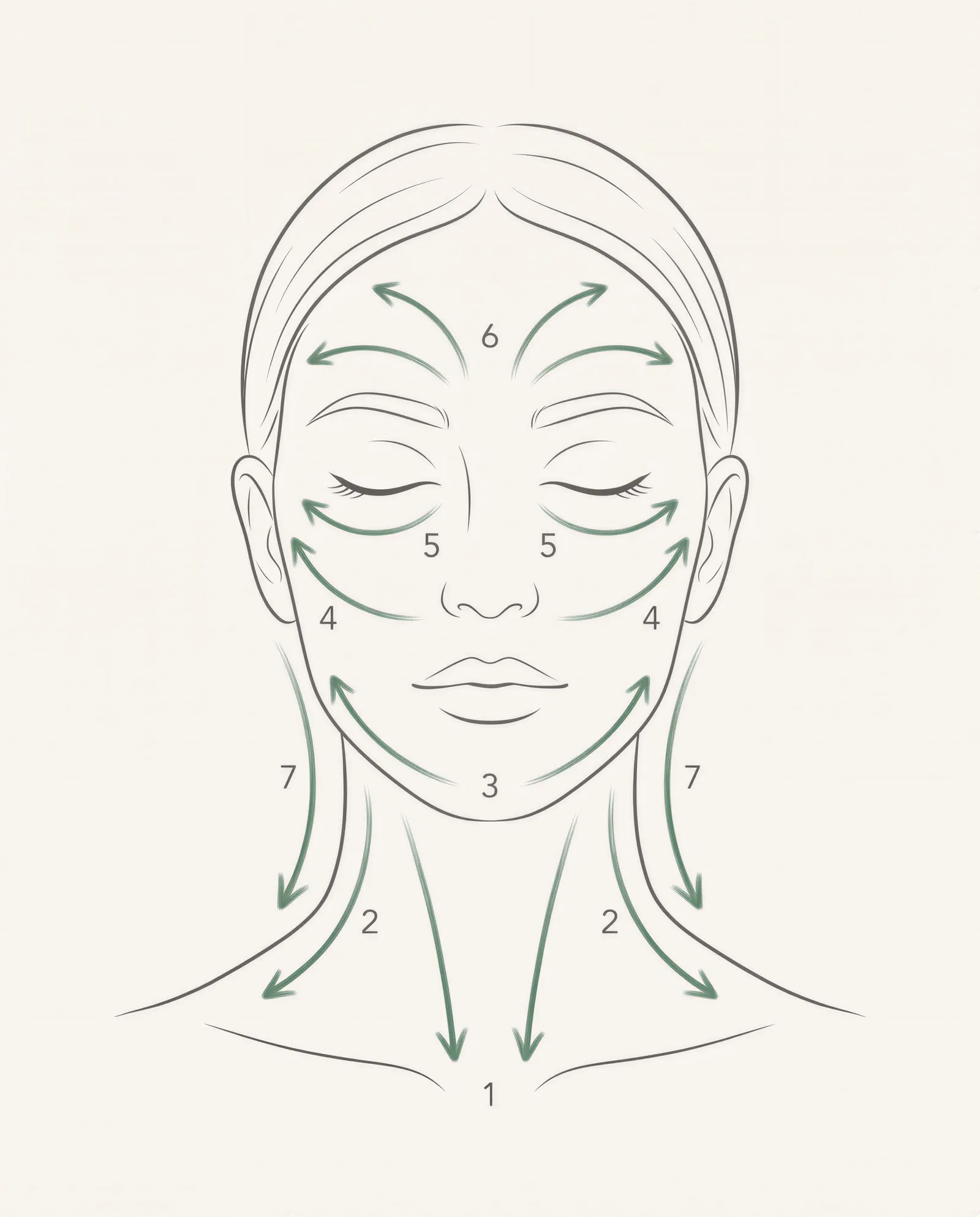
1. Open the collarbone drain (30 seconds). Place two or three fingertips in the soft hollow just above each collarbone. Press gently in and release, in a slow pumping rhythm, about 10 times. Breathe slowly.
2. Clear the sides of the neck (30 seconds). Flat fingers on the skin under your ears. Stroke downward along the side of the neck to the collarbone, 5–10 times each side. Light enough that the skin moves but the muscle doesn't.
3. Jawline, chin to ear (45 seconds). Fingertips at the center of your chin. Glide along the jawline out toward the ear, then down the neck to the collarbone. 5–7 times. This is the stroke that softens a "heavy" jaw in the morning.
4. Cheeks, nose to ear (45 seconds). Flat fingers beside the nose. Sweep outward across the cheek toward the ear, then down the neck. 5–7 times.
5. Under-eyes (45 seconds). Ring fingers only. From the inner corner under the eye, glide outward along the bone to the temple, then down in front of the ear to the neck. 5–7 times. Barely touch; this is the thinnest skin on your face.
6. Forehead and brows (30 seconds). Flat fingers at the center of the forehead. Sweep outward to the temples, then down to the neck. 5 times. Then the same from the center of the brows outward.
7. Finish: neck and collarbones again (30 seconds). Repeat strokes 2 and 1 to send everything you moved into the drain. Take three slow, deep breaths; breathing is part of the pump.
Total: about 4–5 minutes. Cool hands or a cold roller at the end add an extra tightening effect that lasts an hour or two.
Download the 7-stroke face map (printable)
How often, and when
Daily is fine, morning is best if puffiness is your goal, because that's when fluid has pooled. Evening works if your face feels heavy after long screen time or a salty day. There's no benefit to doing it three times a day; once, consistently, beats occasionally and hard. Most people notice the biggest difference after 1–2 weeks of daily practice, not because the face "learns," but because you get faster and lighter with your hands.
What results to expect (honestly)
- Within minutes: softer under-eyes and jawline, a lighter feeling, sometimes a runny nose or the urge to pee (fluid moving).
- Hours: the de-puffed look typically holds through the morning and fades by evening.
- Weeks: no permanent change in face shape. What changes is your baseline: fewer "bad face days" because you clear the overnight fluid every morning.
Studies of manual lymphatic drainage mostly cover swelling after surgery or medical conditions; for everyday cosmetic puffiness the evidence is thin and mostly practitioner experience. We're honest about that, and about the fact that a temporary, visible effect is still worth five minutes to most people. More in Lymphatic drainage before and after.
Mistakes that make it not work
- Pressing hard, as if it were a muscle massage. Lighter than you think.
- Skipping the collarbone step and going straight for the eyes.
- Pushing upward "to lift." Lift is a muscle effect; drainage goes down and out.
- Doing it on dirty skin or with unwashed tools and then wondering about breakouts.
- Expecting it to replace sleep, hydration or less salt. It helps; it doesn't override.
Who should skip it or ask a clinician first
Skip the routine if you have an active skin infection, acute sinus infection, a fever, or open lesions on the face. Talk to a clinician before doing it if you have had facial or neck surgery recently, are being treated for cancer, have a thyroid condition affecting the neck, or have been diagnosed with lymphedema; in those cases a certified lymphedema therapist should guide you. If any stroke hurts, stop; correct drainage never hurts.
Build the rest of your plan
Face is one zone. If you also wake up bloated or with heavy legs, the same principles apply with different strokes: Lymphatic drainage for bloating, Full-body self-massage at home, Dry brushing. Or take the 2-minute quiz and get a plan that fits your zones and your morning.
Build my lymph plan → quiz
Do the neck first. Every stroke on the face drains through the sides of the neck to the collarbones, so a 60-second neck and sinus routine before the face steps is the single change that makes the rest work.
When and how often: mornings win for the face because fluid pools overnight (morning or night?); daily beats intense (how often).
FAQ
How often should I do lymphatic drainage on my face?
Once a day is plenty. Daily gives the most consistent results; two or three times a week still helps.
Should I massage upward or downward?
Downward and outward, toward the ears and then down the neck to the collarbones. That's where the fluid drains. Upward strokes are for muscle-toning routines, not drainage.
How long does the de-puffing last?
Typically several hours, sometimes through the day. It's a daily maintenance habit, not a one-time fix.
Why do I break out after face massage?
Usually pressure, oil or hygiene: hands and tools should be clean, pressure light, and heavy oils avoided if you're acne-prone. Try bare clean fingers first.
Is it supposed to hurt or feel tender?
No. If your neck is sore afterward, you pressed too hard or pushed into muscle. Lymph work should feel almost too gentle.
Can I do it with a gua sha or roller instead of hands?
Yes, same direction, same light pressure, with a little oil so the tool glides. Hands are enough; tools add cooling and consistency. Which tool suits which zone is in what tool is used for lymphatic drainage.
Does it help with a double chin or jaw fat?
It reduces fluid under the jaw, which can visibly sharpen the jawline for the day. It does not remove fat.
Morning or night?
Morning for puffiness, night for a heavy, tired face. Pick the one you'll actually do.
Sources
- Vairo GL et al. Systematic review of efficacy for manual lymphatic drainage techniques in sports medicine and rehabilitation. J Man Manip Ther. 2009.
- Ezzo J et al. Manual lymphatic drainage for lymphedema following breast cancer treatment. Cochrane Database Syst Rev. 2015.
- Cleveland Clinic. How to perform a lymphatic drainage self-massage (patient education).
- Moore JE, Bertram CD. Lymphatic system flows. Annu Rev Fluid Mech. 2018.
Lymph Plan team (Virix Labs). Wellness information, not medical advice. If you have swelling that does not go down, is one-sided, painful or new, see a clinician.