 Lymph Plan
Quick answer: Neck lymphatic drainage is a very light, downward self-massage that helps fluid from your head, face and sinuses reach the lymph nodes along the neck and the "terminal" drain just above your collarbones. It takes 3–5 minutes, uses fingertip pressure light enough to move only the skin, and always runs top down: breathe, open the collarbone hollows, stroke the sides of the neck, behind the ears, along the jaw, then the sinus points from the bridge of the nose out to the ears and down. Most people feel a lighter neck and less pressure around the nose within minutes. Do the neck first, before any face routine: it is the drain everything else empties into.
Build my plan → face
Why the neck comes first
Every drop of lymph from your scalp, face, sinuses, mouth and ears travels down through chains of nodes in the neck (the cervical nodes) and empties into the large veins just above the collarbones. Anatomy texts call this the terminus: the point where the lymphatic system hands its fluid back to the bloodstream. There is no separate exit for the face. Whatever you move in your cheeks or under your eyes has to pass through the neck to leave.
That is why the routine starts at the bottom and every stroke ends at the collarbone. If the neck is tight, the drain is "closed," and working the face just shifts puffiness from one spot to another. Open the neck first and the face routine works noticeably better; on an ordinary day a neck-only session is often enough.
Lymph has no pump of its own. It moves when you breathe deeply, when muscles contract, and when the skin above the vessels is gently stretched. Pressing hard flattens the vessels, which is the opposite of what you want, and it is the most common mistake we see in comments ("I go pretty hard because it feels like a nice massage"). Lighter than that. If the skin turns pink, you have gone too far.
Lymphatic drainage of the neck: the node map, and where each stroke sends fluid
"Lymphatic drainage of the neck" sounds like one thing. Anatomically it is six or seven small clusters of nodes arranged around the jaw, ears and skull, all of them feeding down into the deep cervical chain that runs alongside the big vessels of the neck, and from there into the terminus above the collarbones (1, 4). Knowing which cluster you are working explains why the strokes go where they go.
| Node group | Where it sits | What drains into it | The stroke that serves it |
|---|---|---|---|
| Submental | Under the point of the chin | Chin, lower lip, tip of the tongue, floor of the mouth | Jawline stroke, starting at the centre of the chin |
| Submandibular | Under the jawbone, either side | Cheeks, nose, upper lip, gums | Jawline stroke, chin out to the angle of the jaw |
| Preauricular | Just in front of the ear | Temple, outer eyelid, side of the face | Sinus sweeps that finish in front of the ear |
| Postauricular | In the groove behind the earlobe | Scalp behind the ear, outer ear | Small circles behind the ears |
| Occipital | At the base of the skull, back of the head | Back of the scalp | Shoulder rolls and the back-of-neck sweep |
| Superficial cervical | Along the outside of the big muscle at the side of the neck | Everything above, passing through | Downward strokes on the side of the neck |
| Deep cervical | Along the vessels, deeper in the neck | The final collecting chain for the whole head | Cannot be touched directly; it is served by the strokes above and by deep breathing |
| Supraclavicular (terminus) | The hollows just above the collarbones | The end of the road for the whole head and neck | Collarbone pumps, step 2 |
Two practical conclusions fall out of the map. First, every stroke on the face and neck ends heading downward toward the collarbones, because that is the only exit. Second, the deep cervical chain, the one that actually carries the volume, is not something you press on. It responds to the skin stretch above it and to the pressure changes of a deep breath, which is why step 1 of the routine is breathing and not massage.
If you want the bigger picture of where this fluid goes after the collarbones, how the lymphatic system works traces the route into the thoracic duct and the veins.
The 3–5 minute neck routine
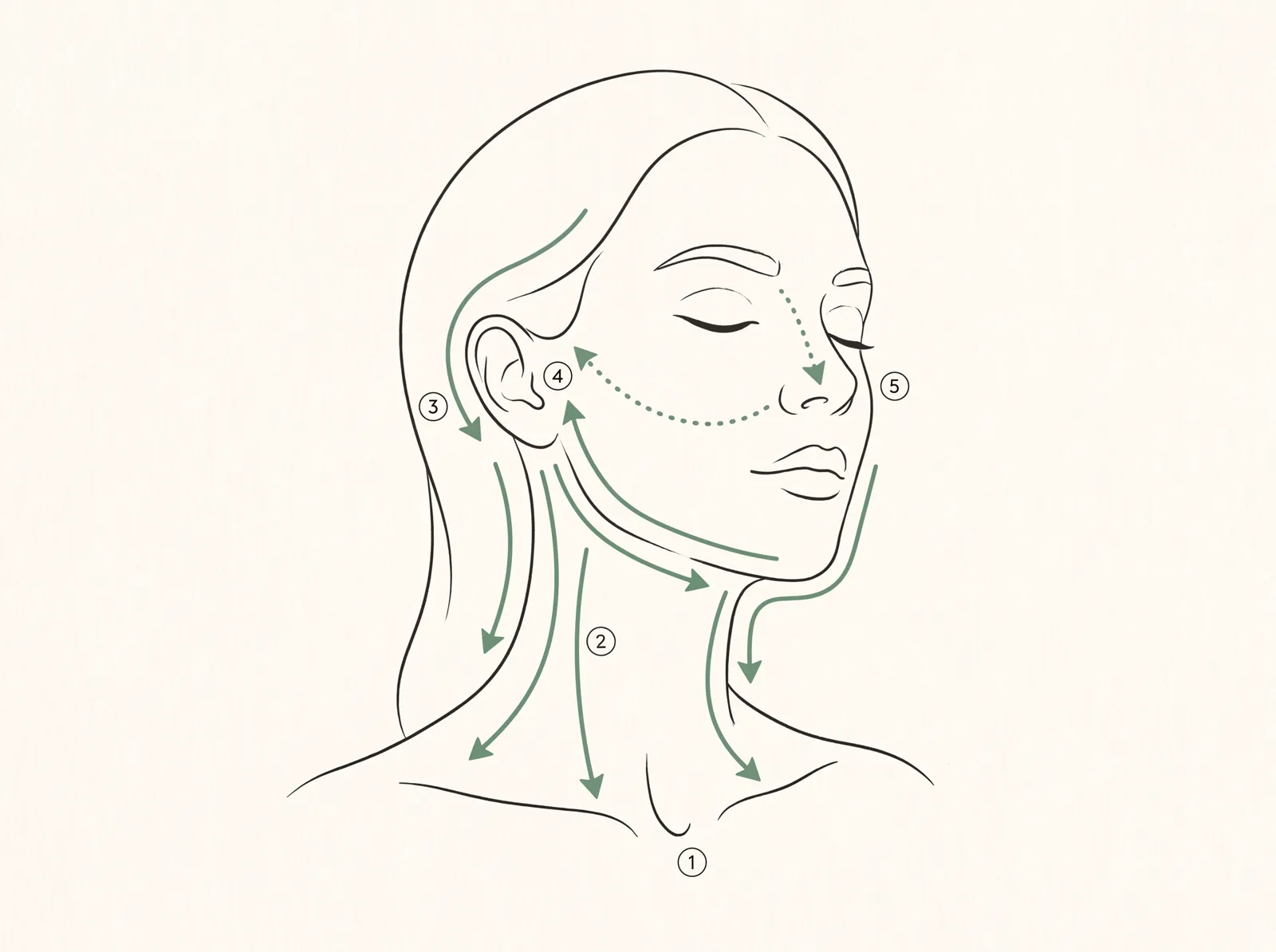
Sit upright with relaxed shoulders. Clean hands; oil is optional. Every stroke is slow, about one second each, skin moving, muscle not.
1. Deep breaths (30 seconds). Hands on your lower ribs. Five slow breaths that widen the ribs and drop into the belly. The diaphragm is the biggest lymph pump you have, and it primes the main duct the neck empties into.
2. Collarbone hollows (30 seconds). Two or three flat fingertips in the soft hollow just above each collarbone, beside the base of the neck. Press gently down and slightly inward, release, in a slow pumping rhythm, 10–15 times. This is the terminus. Nothing else works well until it is open.
3. Side of the neck, downward (45 seconds). Flat hands on the skin just under your ears. Stroke straight down the side of the neck to the collarbone, 7–10 times each side. Think "stretching a sheet," not "rubbing a muscle."
4. Behind the ears (30 seconds). Two fingers in the groove behind each earlobe, where the jaw meets the skull. Small slow circles, 5–7 times, then stroke from there down the neck to the collarbone, 5 times. The nodes here collect from the scalp and outer ear.
5. Jawline toward the ear (45 seconds). Fingertips at the center of the chin, under the jawbone. Glide along the underside of the jaw out to the angle below the ear, then down the neck to the collarbone. 5–7 times. This is the stroke that softens a heavy, "thick" feeling under the jaw in the morning.
6. Sinus points (60–90 seconds). The sequence for a stuffy, pressured face. Each step ends by sending fluid down the neck:
- Bridge of the nose. Index fingers either side of the bridge, at the inner corners of the eyes. Gentle press-and-release, 5 times, then sweep out along the brow bone to the temples and down in front of the ears.
- Under the cheekbones. Fingertips in the hollow under the cheekbones, beside the nostrils. Press gently up into the bone and release, 5 times, then sweep outward along the cheekbone toward the ears.
- Toward the ears. Flat fingers beside the nose, sweep across the cheek to the ear, 5 times.
- Down the neck. Repeat stroke 3, 5 times, then one last set of collarbone pumps.
Total: 3–5 minutes. Finish with three slow breaths. A runny nose or the urge to swallow during step 6 is normal; that is fluid moving.
What it can do for sinus congestion, and what it can't
The lining of the nose and the tissues around the sinuses drain through the same facial and neck nodes as the rest of the face. Gently working that route can make the face feel less tight and the nose less blocked for a while, which is why "lymphatic drainage for sinus" is such a common search and why people often describe a "release" during the routine.
Be clear about the limits. Self-massage does not clear infected mucus from a sinus cavity, shrink swollen sinus lining, or treat a sinus infection. ENT guidance from the American Academy of Otolaryngology (AAO-HNS) and the NHS for sinus symptoms centers on saline rinses or sprays, steam, fluids, rest, simple pain relief, and seeing a clinician if symptoms are severe, one-sided, last beyond about 10 days, or come with high fever or swelling around the eyes. Treat the neck routine as something you do alongside a saline rinse to feel more comfortable, never instead of what actually treats the problem.
Skip it entirely while you have an acute infection with fever or a hot, tender face. Use it in the recovery week, when the lingering "full" feeling is mostly fluid.
Tech-neck, tension, and why a tight neck feels "clogged"
Hours with the head forward over a phone or laptop shorten the muscles at the front of the neck and stiffen the ones at the back. Tight tissue and shallow breathing both slow lymph flow, so a tech-neck day often ends with a puffy jaw, a dull ache behind the ears, and a heavy head. Very few of those people have anything wrong with their lymph nodes. What they have is a neck that has not moved.
The routine helps because it combines the three things that move lymph here: deep breathing, gentle skin stretch, and a few minutes with the head upright. Add movement and it works better again: five slow backward shoulder rolls, five chin tucks, and turning the head side to side before you start. If tension is your main complaint, pair this page with the mobility drills in Lymphatic exercises; they move more fluid than hands do.
How often, and how to fit it into a plan
Daily, morning or evening, whichever you will actually do. Morning if you wake with a puffy jaw or blocked nose; evening after a long screen day. Once a day is plenty. If you prefer a stone to fingers, the three-stroke version is in gua sha for lymphatic drainage of the neck. If you also do a face routine, do the neck first every time. Dry brushing the neck is an alternative: same downward direction, same light pressure. A gua sha works well on the sides of the neck and along the jaw as long as it stays light.
Not sure the neck is your zone? Signs of sluggish lymph covers what everyday fluid retention looks like in the face, belly and legs, and Before and after shows what realistic results are (temporary, visible, worth the minutes) and what they are not.
Build my lymph plan → quiz
Draining lymph nodes in the neck: what you can and cannot do
Searches for "draining lymph nodes in the neck" usually come from one of two places: a neck that feels thick and heavy after a screen day, or a node you can feel under your fingers and would like to make go away. Those need opposite answers.
| What you want to do | Can a home routine do it? | What to do instead |
|---|---|---|
| Move everyday fluid through the neck so the face and jaw feel lighter | Yes. This is exactly what the routine above is for | Do it daily, light pressure, always downward |
| "Open" or "unblock" the neck before a face routine | Yes, in the practical sense: collarbone pumps first make the face work better | Steps 1–3, thirty seconds each |
| Shrink a node that is swollen because you have a cold or sore throat | No, and do not try | Leave it alone. Reactive nodes settle by themselves in one to three weeks |
| Massage a node that is hot, red or tender | No — this can make it more painful | Hands off; see a clinician if it is not settling |
| "Drain" nodes that feel enlarged but never change | No | Get them checked; anything unchanged past 2–3 weeks needs a doctor |
| Reduce a thick, heavy feeling at the base of the skull after screen time | Yes, partly — but movement does more than hands | Shoulder rolls, chin tucks, then the routine; lymphatic yoga covers the neck and shoulders in a 10-minute sequence |
| Reduce morning puffiness under the eyes | Indirectly, and it is the right first step | Neck first, then the under-eye and puffy-face routine |
The distinction that matters: you are moving fluid through the neck, not emptying nodes. A lymph node is a filter with immune cells in it, not a sac of fluid waiting to be squeezed. When a node swells during an infection, it is full of white blood cells doing their job, and pressing on it achieves nothing except soreness. When the neck feels heavy on an ordinary day, that is interstitial fluid in the tissue around the nodes, and gentle downward strokes genuinely move it.
Hands, gua sha or a brush: what to use on the neck
All three work, because all three do the same thing — stretch the skin toward the collarbones at a pressure that would not crease a sheet of paper. The differences are practical.
| Best for | Pressure cue | Notes | |
|---|---|---|---|
| Bare hands | Everything; the only option for the collarbone pumps and sinus points | The weight of a coin | No setup, no slip, works dry. Start here |
| Gua sha stone | The sides of the neck and along the jaw, in long strokes | The stone should glide, never drag | Needs a slip of oil; skin must never go red. The three-stroke neck version is here |
| Dry brush | The back and sides of the neck, as part of a whole-body routine | Feather-light, always downward | Dry skin only; skip the face and the front of the throat. See dry brushing |
| Vibrating or heated wands | Nothing the hands cannot do | — | The evidence for devices is thin; treat them as comfort items, not upgrades |
Whatever you use, the front of the throat over the windpipe and the pulse points on the side of the neck are not massage targets. Stay on the soft tissue, keep it light, and stop if anything feels tender.
Red flags: when a neck is not a routine problem
This page is wellness education for everyday puffiness and tension. It is not a way to "shrink lymph nodes," and it must not be used on a node that is inflamed. Never massage over a node that is hot, red, painful or swollen from an infection. See a doctor promptly if you notice:
- A neck lump that is hard, fixed in place, or painless and growing. Normal reactive nodes are soft, slightly tender and move under the skin.
- Swollen nodes lasting longer than 2–3 weeks, or still growing, especially without a cold or sore throat to explain them.
- Swelling with night sweats, unexplained weight loss, or persistent fever.
- Swelling in the neck or face after thyroid, neck or head surgery, or radiation. That can be lymphedema and belongs with a certified lymphedema therapist, not a DIY routine.
If you are being treated for cancer, have a thyroid condition, or have had a recent neck procedure, ask your clinician first. If any stroke hurts, stop; correct drainage never hurts.
FAQ
Can I do lymphatic drainage on my own neck?
Yes. Everything drains to one place, the hollows above the collarbones, and the whole routine is done seated with your hands. Open the collarbones first, then stroke downward.
How do I know if my lymphatic system is "clogged"?
Healthy lymph doesn't clog; what people notice is everyday fluid retention: a puffy face in the morning, a thick jaw, a tight neck after screen time, heaviness that eases once you move. Persistent, hard or one-sided swelling is a different thing and needs a doctor.
How do I get rid of fluid build-up in my neck?
Deep breathing, the collarbone pumps, downward strokes, then moving: a walk, shoulder rolls, an upright posture. Less salt and alcohol, more water. Fluid that stays for days or sits on one side needs a clinician.
Can neck massage shrink swollen lymph nodes?
No, and you should not try. Swollen nodes are usually your immune system working during an infection; they settle on their own within a couple of weeks. Massaging an inflamed node can make it more tender. Nodes still enlarged after 2–3 weeks need to be checked.
How much pressure should I use? The sides of my neck hurt.
If it hurts, it was too much. Lymph vessels sit just under the skin; the right touch moves the skin a few millimeters and nothing underneath. The weight of a coin, not the force of a massage.
Does lymphatic drainage help with sinus pressure?
It can make a full, pressured face feel lighter for a while. It does not treat sinusitis. Use it alongside saline rinses and steam, and see a clinician for severe or long-lasting symptoms.
Neck first or face first?
Neck first, always. Then face, then the rest of your at-home routine; the stomach and legs pages use the same principle with their own drains.
Which lymph nodes are in the neck?
Several small clusters: under the chin and jaw, in front of and behind the ears, at the base of the skull, and two chains running down the side of the neck — the superficial one you can affect with strokes, and the deep one that carries the volume. All of them empty into the hollows above the collarbones.
How do you drain the lymph nodes in your neck at home?
You do not drain the nodes; you move the fluid around them toward the collarbones. Breathe deeply, pump the collarbone hollows, then stroke downward from behind the ears and along the jaw to the collarbones. Three to five minutes, light enough that only the skin moves.
How long does neck lymphatic drainage take to work?
Most people feel a lighter neck and a less pressured face within the session itself, and see a difference in the morning jaw and under-eyes after a few consecutive days. The effect is temporary by design — it is fluid, and fluid comes back; how long results last covers the timeline.
Can I do neck lymphatic drainage every day?
Yes. It is light enough to be a daily habit, and daily is where the benefit is; once a day is plenty. Morning suits a puffy jaw or blocked nose, evening suits a screen day — see morning or night.
Do I need oil for the neck?
Not for the hand routine; dry skin gives the grip you want for a skin stretch. You do need a slip of oil for a gua sha stone, or it drags. Dry brushing is the opposite again: dry skin only.
Sources
- Földi M, Földi E (eds). Földi's Textbook of Lymphology for Physicians and Lymphedema Therapists. 3rd ed. Elsevier Urban & Fischer, 2012.
- Wittlinger H, Wittlinger D, Wittlinger A, Wittlinger M. Dr. Vodder's Manual Lymph Drainage: A Practical Guide. Thieme, 2011.
- Ezzo J, Manheimer E, McNeely ML, et al. Manual lymphatic drainage for lymphedema following breast cancer treatment. Cochrane Database Syst Rev. 2015;(5):CD003475.
- Standring S (ed). Gray's Anatomy: The Anatomical Basis of Clinical Practice. 42nd ed. Elsevier, 2020. Neck: cervical lymph nodes, thoracic duct and right lymphatic duct.
- Río-González Á, Cerezo-Téllez E, Gala-Guirao C, et al. Effects of different neck manual lymphatic drainage maneuvers on the nervous, cardiovascular, respiratory and musculoskeletal systems in healthy students. J Clin Med. 2020;9(12):4062. PMC7765613.
- Rosenfeld RM, Piccirillo JF, Chandrasekhar SS, et al. Clinical practice guideline (update): adult sinusitis. Otolaryngol Head Neck Surg. 2015;152(2 Suppl):S1–S39. (AAO-HNS.)
- NHS. Sinusitis (sinus infection); Swollen glands. nhs.uk/conditions.
- West Suffolk NHS Foundation Trust. How to do self-lymphatic massage on your head and neck (patient leaflet).
Lymph Plan team. Wellness information, not medical advice. A neck lump that is hard, fixed, painless and growing, or node swelling lasting more than 2–3 weeks, needs a doctor, not a routine.