 Lymph Plan
Quick answer: Yoga moves lymph because it runs all three of the pumps the lymphatic system depends on: deep breathing (the diaphragm is the biggest lymph pump you have), muscle contraction (every hold squeezes the vessels running between the muscles), and gravity (legs above the heart lets fluid drain back down toward the chest). The eight poses below — deep belly breathing, neck rolls, cat-cow, thread the needle, downward dog, bridge, reclined butterfly and legs up the wall — cover every drainage route from the collarbones to the ankles. Ten minutes a day is enough to feel lighter legs and a less puffy face. What yoga does not do is "detox" you or flush anything out; there is nothing to flush.
which zones puff up for you? → a 5-minute routine; the sequence below is the movement half of it
Why yoga moves lymph at all
Blood has a heart. Lymph does not. The two to four litres of clear fluid that leak out of your capillaries into the tissue every day are collected by lymph vessels and pushed back to the veins near your collarbones by nothing more than the squeeze of the tissue around them (1). Three things do that squeezing, and a yoga session does all three at once.
1. The diaphragm. Every deep breath drops the diaphragm, drops the pressure inside the chest, and pulls fluid up the thoracic duct — the main lymph highway that runs up the middle of your body and empties just above the left collarbone. Slow breathing measurably increases lymph flow through that duct, which is why every drainage protocol, hands or mat, starts with breathing (2).
2. The muscle pump. Lymph vessels sit in and between the muscles. When a muscle contracts, it squeezes them; one-way valves inside the vessels mean the fluid can only go one direction, toward the nodes. A held pose is a long, low-grade contraction of a lot of muscle at once, which is exactly the stimulus the system was built for (1).
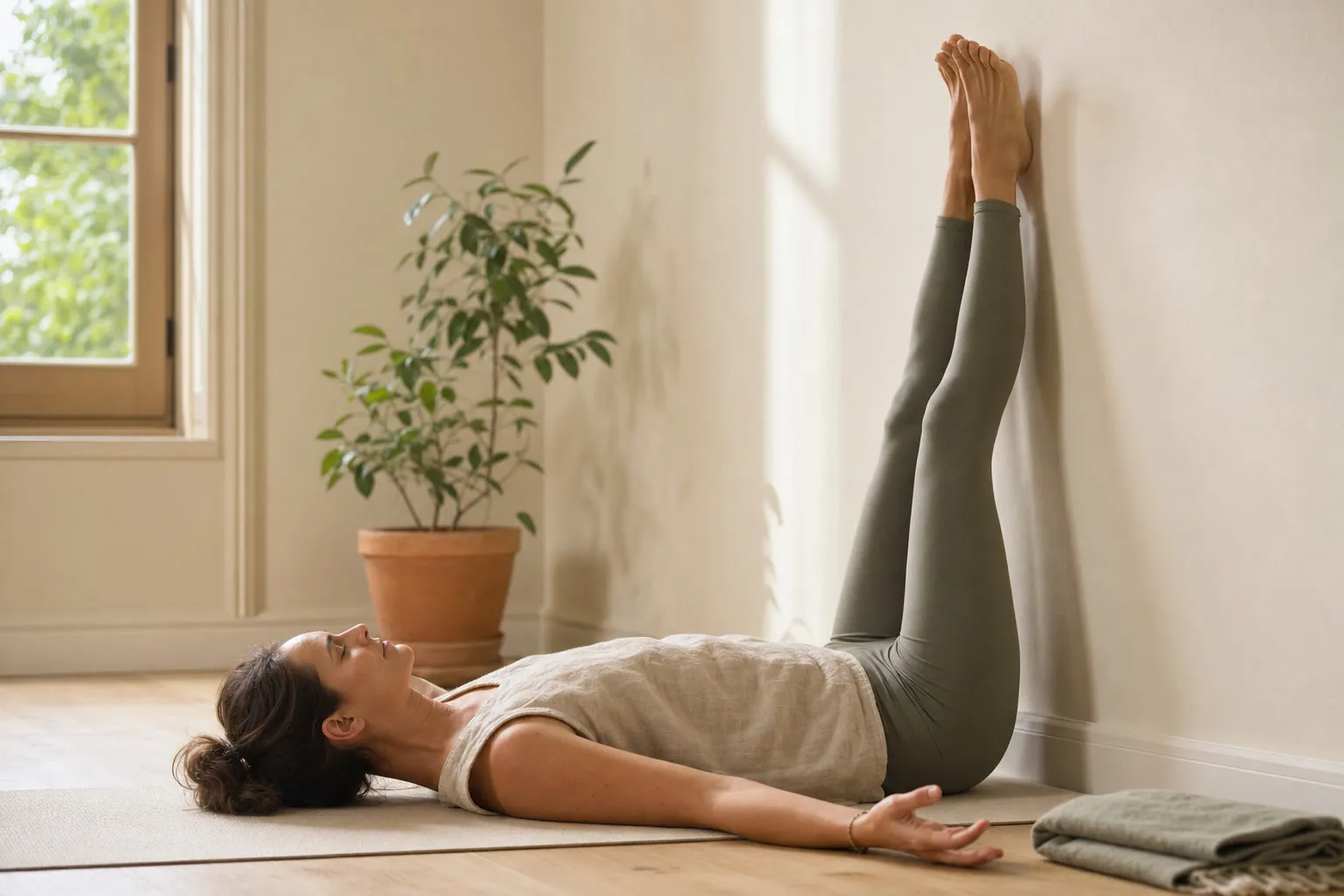
3. Gravity. Most of the fluid that pools by evening pools in your legs, because your legs are below your heart for sixteen hours a day. Put them above your heart and gravity stops working against the drain and starts working for it. That is the whole mechanism behind legs up the wall, and it is the least mystical thing in this article.
There is a fourth, softer reason. Slow yoga breathing shifts you toward the parasympathetic side of the nervous system, and a small controlled study of neck drainage manoeuvres found the same shift there: heart rate down, breathing slower, people calmer (3). Less clenching, deeper breathing, better flow. It is real, it is modest, and it is not a detox.
The 8 poses, and what each one is actually for
Every pose below is here for a mechanical reason, not a vibe. "Drain" in the last column means the node cluster the fluid is being sent toward.
| Pose | What it does for lymph | Drain it serves | Hold |
|---|---|---|---|
| Diaphragmatic breathing (seated or lying) | Runs the biggest pump you have; primes the thoracic duct before anything else | Collarbones (terminus) | 1 min, 8–10 breaths |
| Neck rolls and shoulder circles | Opens the neck and the hollows above the collarbones, where all head and face fluid exits | Neck, collarbones | 45 sec |
| Cat-cow | Alternating belly compression and release; moves the deep abdominal vessels and the cisterna chyli behind the navel | Abdomen, thoracic duct | 45 sec, 8 rounds |
| Thread the needle (or any gentle twist) | Compresses one side of the torso and releases the other, like wringing a sponge; also opens the armpit | Armpits, abdomen | 30 sec each side |
| Downward dog | Mild inversion: hips above heart, heels pumping the calves, deep breathing under load | Legs, groin, chest | 30–45 sec |
| Bridge (or supported bridge) | Hips above heart with the glutes and hamstrings contracting; opens the front of the hips where the groin nodes sit | Groin, legs, abdomen | 30 sec × 2 |
| Reclined butterfly (supta baddha konasana) | Passive groin opening with the belly soft, so the abdominal and inguinal routes are unobstructed | Groin, abdomen | 1–2 min |
| Legs up the wall (viparita karani) | Gravity does the work for the legs and ankles; the classic evening de-puff | Legs, ankles, groin | 3–5 min |
Two poses do most of the visible work: legs up the wall for heavy legs and sock marks, and cat-cow for a tight, bloated belly. If you only have three minutes, do those two and the breathing.
The 10-minute lymphatic yoga sequence
Do it barefoot, on an empty-ish stomach, in the order below. Move slowly: this is not a workout, and rushing skips the point. A wall and a mat are all you need.
0:00–1:00 — Belly breathing, lying on your back. Knees bent, feet flat, one hand on your ribs and one on your belly. Breathe in through the nose for four counts so the ribs widen and the belly rises, out for six. Eight to ten breaths. Every pose after this keeps the same breath.
1:00–1:45 — Neck and shoulders, seated. Ear toward one shoulder, hold three breaths, slowly to the other side. Then five backward shoulder rolls. If your face is your puffy zone, add the collarbone pumps from the neck routine here — it is thirty seconds and it opens the drain everything else empties into.
1:45–2:30 — Cat-cow, on hands and knees. Inhale, belly drops and chest opens; exhale, spine rounds and the belly pulls in. Eight slow rounds. Feel the belly compress and release: that is the point.
2:30–3:30 — Thread the needle, both sides. From hands and knees, slide one arm under the other through to the opposite side, shoulder and cheek resting on the mat. Three breaths, then the other side. Repeat once each. Gentle twist, no force.
3:30–4:15 — Downward dog, with heel pedals. Hands and feet on the mat, hips up. Pedal the heels — bend one knee, press the other heel down, alternate — for thirty seconds. This is the calf pump working while you are half-inverted. Come down to child's pose for three breaths if your arms complain.
4:15–5:15 — Bridge, twice. On your back, knees bent, feet hip-width. Press through the heels and lift the hips for five breaths, lower slowly, repeat. For a restorative version, slide a block or a folded cushion under the sacrum and just rest there.
5:15–6:30 — Reclined butterfly. Soles of the feet together, knees falling open, hands on the belly. Cushions under the knees if the groin feels stretched — it should not. Six to eight slow breaths.
6:30–10:00 — Legs up the wall. Sit sideways against the wall, swing your legs up, shuffle your hips close, arms out. Three to five minutes. Flex and point the feet ten times when you settle, and again before you come out — the ankle pumps move more fluid than lying still does. Roll to one side to come out, slowly.
Finish with three deep breaths sitting up. Total: ten minutes. On days when you also do hands-on work, do the yoga first and the self-massage second: the movement fills the drains, the massage clears the last bit.
Does yoga drain the lymphatic system? What the evidence shows
| Claim | What the research actually supports | Status |
|---|---|---|
| Deep breathing increases lymph flow in the thoracic duct | Measured directly; respiration is one of the main drivers of central lymph flow (2) | Proven |
| Muscle contraction pumps lymph along the limbs | Basic lymphatic physiology; exercise raises lymph flow several-fold over rest (1) | Proven |
| Elevating the legs reduces evening leg and ankle swelling | Standard, long-standing advice in venous and lymphoedema care; gravity is the mechanism | Proven |
| A yoga session reduces everyday puffiness (face, belly, ankles) | Plausible from the three mechanisms above; small, same-day effects; no large trial in healthy people | Plausible |
| Yoga helps arm swelling after breast-cancer treatment | Small randomised trials report improved quality of life and, in some, reduced limb volume; results are mixed and supervised programs were used (4) | Promising, supervised only |
| Yoga "detoxes" the body or flushes toxins out of the lymph | No toxin is named, measured or removed in any of this literature; reviews of detox practices find no supporting evidence (5) | Not supported |
| Inversions "reverse the flow" and clear the whole system | Gravity helps fluid already in the legs move centrally. Nothing "reverses"; the valves only open one way | Overstated |
| Twisting "wrings out" the lymph nodes | Twists compress soft tissue, which does move fluid. Nodes are not sponges and are not squeezed empty | Overstated |
The honest summary is the same one that fits every page on this site: the mechanism is real and well documented, the everyday cosmetic effects are small, same-day and repeatable, and the dramatic claims have never been measured. Our full evidence round-up is in what lymphatic drainage can and cannot do.
Yoga vs walking vs rebounding vs hands: what is the best exercise for lymphatic drainage?
"What is the best exercise for lymphatic drainage?" is one of the most asked questions in this topic, and the honest answer is the one you will do daily. Here is how the options actually compare.
| What it is best at | Time | Gets you | Watch out for | |
|---|---|---|---|---|
| Yoga | The whole body at once: breath, torso, groin, legs, plus the only easy way to get your legs above your heart | 10 min | Lighter legs, softer belly, calmer nervous system | Inversions are not for everyone (see safety below) |
| Walking | Sheer volume of calf-pump contractions; the most lymph moved per minute | 20–30 min | Ankles, legs, general circulation | Needs shoes, weather, time |
| Rebounding | Rhythmic, whole-body calf and core pumping in a small space | 5–10 min | Legs, energy | Needs a rebounder; pelvic floor considerations |
| Self-massage | Precision: the face, the jaw, one swollen ankle | 5 min | Face and targeted zones | Does nothing for the rest of you |
| Vibration plate | Passive muscle activation when standing is hard | 10 min | Legs | Weakest evidence of the five; expensive |
Stack them if you like: walk in the morning, ten minutes of yoga in the evening, hands for the face when it is puffy. That is the at-home routine most people end up with.
How often, when, and what to expect
Daily is fine. This is gentle movement, not training; there is nothing to recover from. If daily is unrealistic, three or four times a week still shifts an evening-heavy-legs pattern.
Evening for legs, morning for face. Legs up the wall works best when the swelling has already accumulated — after work, after a flight, after a day standing. Face puffiness is a morning problem, so put the breathing, neck and gentle inversion part of the sequence before your coffee. More on timing in morning or night.
What you should notice. Lighter legs and less ankle swelling the same evening, often within the five minutes at the wall. A flatter-feeling belly after the cat-cow and twist section, sometimes with a trip to the bathroom. A less puffy face the next morning after a few days. What you should not expect is fat loss, a permanent change in shape, or anything at all if the swelling is one-sided or painful — see the red flags below. Timelines are in how long results last and how often to do it.
The most common beginner mistake is pushing into stretch. This is not flexibility work. If a pose is intense, you have left the zone where soft-tissue compression helps and entered the one where tension slows everything. Cushions everywhere, always.
Build my lymph plan → quiz
Desk-day version, in three minutes
For the day you never get on the mat. Done in a chair, or a chair and a wall:
- Seated cat-cow, hands on knees, eight rounds.
- Seated twist, hand on the opposite knee, three breaths each side.
- Ankle pumps and circles under the desk, twenty each foot, every hour. This is the single highest-value thing a sitting person can do for their legs; heavy legs and swollen ankles cover why.
- Ten deep belly breaths, ideally standing.
- Legs up a wall for two minutes when you get home, or up the sofa back. After a flight, make it five — see after a flight.
Safety: who should modify or skip the inversions
The gentle floor work suits almost everyone. The head-below-heart and legs-above-heart parts are where care is needed. Skip or modify inversions, including legs up the wall and downward dog, if you have:
- Glaucoma or other raised eye pressure, or a recent eye procedure — inversions raise intraocular pressure.
- Uncontrolled high blood pressure, or dizziness on standing.
- Heart failure or kidney failure. Moving a large volume of pooled fluid centrally is a real cardiovascular load, not a metaphor. Ask your clinician first.
- Reflux (GERD) — head-down positions are a reliable way to make it worse; do the sequence upright and skip the wall, or wait three hours after eating.
- Neck problems, especially anything involving the cervical spine — no shoulder stand, no plough, ever, without supervision.
- Pregnancy. Skip deep twists and belly-down work; lying flat on the back is usually discouraged after the first trimester. Legs up the wall is often still comfortable and is worth asking your midwife about, since swollen ankles are common.
- An active infection with fever, a hot or painful area, a known blood clot, or a swollen, red, tender limb. Stop and call a clinician; this is on the side effects and who should not do lymphatic drainage list.
- Lymphoedema after surgery, node removal or radiation. Yoga can be part of care, but it should be programmed by a certified lymphoedema therapist alongside compression, not self-prescribed from an article.
And the flag that matters most: a lump that is hard, fixed in place, painless and growing, or swelling that is on one side only, or swelling that has not settled in two to three weeks, is not a routine problem. See a doctor. Everything on this page is for ordinary, both-sides, comes-and-goes puffiness; signs of sluggish lymph draws the line in more detail.
FAQ
Does yoga drain the lymphatic system?
It helps it do its own job. Yoga runs the three pumps that move lymph — deep breathing, muscle contraction, and gravity when your legs go above your heart — so fluid returns to the bloodstream faster than it would while you sat still. It does not "drain" or empty anything, and there is nothing toxic being removed.
What are the best yoga poses for lymphatic drainage?
Legs up the wall for the legs and ankles, cat-cow and a gentle twist for the belly, bridge for the hips and groin, reclined butterfly for the groin, downward dog as a mild inversion, and neck and shoulder work to open the collarbone drain. Start every session with a minute of belly breathing.
How long should I hold legs up the wall for lymphatic drainage?
Three to five minutes is the sweet spot for everyday heavy legs; up to ten if you have been standing all day or just got off a plane. Add ten flex-and-point ankle pumps at the start and the end. Longer is not better, and coming out slowly matters more than the total time.
How often should I do lymphatic yoga?
Daily if you like it — it is gentle enough. Three or four sessions a week is enough to change an evening-swelling pattern. Consistency beats duration: ten minutes most days does far more than an hour on Sunday.
Can yoga replace a lymphatic drainage massage?
For the body, mostly yes, and it moves more fluid than hands do because it works whole muscle groups. For the face, no — nothing on a mat reaches the jaw and under-eyes, so pair the sequence with the face and neck routines.
What is the best exercise for lymphatic drainage?
Walking, by total volume of calf-pump contractions. Yoga wins on breadth — it is the only one that covers the breath, the torso and an inversion in ten minutes — and rebounding wins on time per minute. The best one is whichever you do without negotiating with yourself.
How do I know if my lymphatic system is blocked?
Healthy lymph does not block. What people notice is ordinary fluid retention: a puffy face in the morning, rings that are tight by evening, sock marks, a belly that grows through the day and settles overnight. Swelling that is one-sided, hard, painful, hot, or lasting more than two to three weeks is a different thing and needs a doctor.
Can I do lymphatic yoga while pregnant?
Ask your midwife or obstetrician first. Deep twists, belly-down poses and lying flat on the back are usually modified or dropped after the first trimester. Gentle breathing, seated movement and legs elevated on a chair or cushions are often fine and commonly recommended for swollen ankles.
Do I need to drink more water afterwards?
Drink normally. There is no flush to support; the fluid you move goes back into the bloodstream and leaves through the kidneys on its own schedule. A glass of water is a good habit, two litres immediately after a session is just a wet afternoon.
Why do I need the bathroom after a session?
Because you moved fluid centrally and your kidneys did the rest, and because the cat-cow and twist section nudges gas and stool along. Both are normal and neither means toxins left your body.
Sources
- Breslin JW, Yang Y, Scallan JP, Sweat RS, Adderley SP, Murfee WL. Lymphatic vessel network structure and physiology. Compr Physiol. 2018;9(1):207–299. https://pmc.ncbi.nlm.nih.gov/articles/PMC6459625/
- Moore JE, Bertram CD. Lymphatic system flows. Annu Rev Fluid Mech. 2018;50:459–482. (Respiration, muscle contraction and posture as the drivers of lymph flow.)
- Río-González Á, Cerezo-Téllez E, Gala-Guirao C, et al. Effects of different neck manual lymphatic drainage manoeuvres on the nervous, cardiovascular, respiratory and musculoskeletal systems in healthy students. J Clin Med. 2020;9(12):4062. https://pmc.ncbi.nlm.nih.gov/articles/PMC7765613/
- Loudon A, Barnett T, Piller N, Immink MA, Williams AD. Yoga management of breast cancer-related lymphoedema: a randomised controlled pilot-trial. BMC Complement Altern Med. 2014;14:214. https://pmc.ncbi.nlm.nih.gov/articles/PMC4083869/
- Klein AV, Kiat H. Detox diets for toxin elimination and weight management: a critical review of the evidence. J Hum Nutr Diet. 2015;28(6):675–686.
- Ezzo J, Manheimer E, McNeely ML, et al. Manual lymphatic drainage for lymphedema following breast cancer treatment. Cochrane Database Syst Rev. 2015;(5):CD003475.
- Standring S (ed). Gray's Anatomy: The Anatomical Basis of Clinical Practice. 42nd ed. Elsevier, 2020. (Thoracic duct, cisterna chyli, inguinal and axillary node groups.)
- Baskaran M, Raman K, Ramani KK, Roy J, Vijaya L, Badrinath SS. Intraocular pressure changes and ocular biometry during Sirsasana (headstand posture) in yoga practitioners. Ophthalmology. 2006;113(8):1327–1332.
- Cramer H, Ward L, Steel A, Lauche R, Dobos G, Zhang Y. Prevalence, patterns, and predictors of yoga use: results of a U.S. nationally representative survey. Am J Prev Med. 2016;50(2):230–235. (Context on practice patterns and safety reporting.)
- NHS. Swollen ankles, feet and legs (oedema); when to get medical help. nhs.uk/conditions/swollen-ankles-feet-and-legs
Lymph Plan team (Virix Labs). Educational content, not medical advice. One-sided, painful, hot or persistent swelling, and any lump that is hard, fixed or growing, needs a doctor rather than a routine.