 Lymph Plan
Quick answer: You land puffy because you sat still for hours in a dry, low-pressure cabin, probably ate salty food, and gravity pulled fluid into your feet while your calf muscles did nothing to send it back. The fix is mechanical: breathe deeply, open the collarbones, clear the neck and face, then pump the groin creases, stroke the thigh, calf and ankle toward the heart with feather-light pressure, do calf pumps, and finish with legs up the wall. Ten minutes the evening you land, the top half again next morning. Everyday travel swelling fades on its own within a day or two; the routine speeds up what your body is already doing. One-sided calf swelling with pain, warmth or redness, or chest pain or shortness of breath after a flight, is not a puffiness problem and must not be massaged: it needs emergency care.
Build my plan → legs
Read this first: the one kind of post-flight swelling you never massage
Red flags after a flight. Long periods of sitting, especially on flights of several hours or more, raise the risk of a clot in a deep leg vein (deep vein thrombosis, DVT). Part of that clot can travel to the lungs (pulmonary embolism, PE). Get emergency help, and do not massage the leg, if in the hours or days after flying you notice:
- swelling in one leg or calf, especially with pain, tenderness, warmth or redness;
- chest pain, sudden shortness of breath, a racing heart, coughing up blood, or feeling faint.
Everyday travel swelling is soft, on both sides, painless, and clearly better by the next morning. Anything that breaks that pattern goes to a clinician, not to a routine. This page is wellness education for the ordinary, two-sided kind.
Why you swell on a plane
Four things happen at once in a cabin, and none of them means your lymphatic system is "failing".
You sit still. Lymph and venous blood leave the legs mostly because the calf muscles squeeze the vessels every time you walk. In a seat with your feet on the floor, that pump is off for hours, so fluid pools around the ankles and the tops of the feet. It is the heavy-legs-after-a-desk-day problem, only longer. The legs page covers the everyday version.
Cabin pressure and dry air. Cabins are pressurised to something like a mountain altitude rather than sea level, and the air is very dry. You lose water through breathing and skin without noticing, drink less than at home, and the body responds by holding on to fluid. That is how you end up dehydrated and puffy at the same time.
Salty food. Cabin meals and snacks are heavily salted, partly because taste dulls at altitude. Sodium makes the body retain water for a day or so, and it shows first in the face, fingers and ankles.
Alcohol. A drink on board dehydrates you further, disrupts sleep, and usually comes with more salt. Wine plus a red-eye is the classic recipe for a swollen face and tight shoes.
If you feel puffy on ordinary days too, Signs of sluggish lymph explains what everyday retention looks like.
The 10-minute post-flight routine
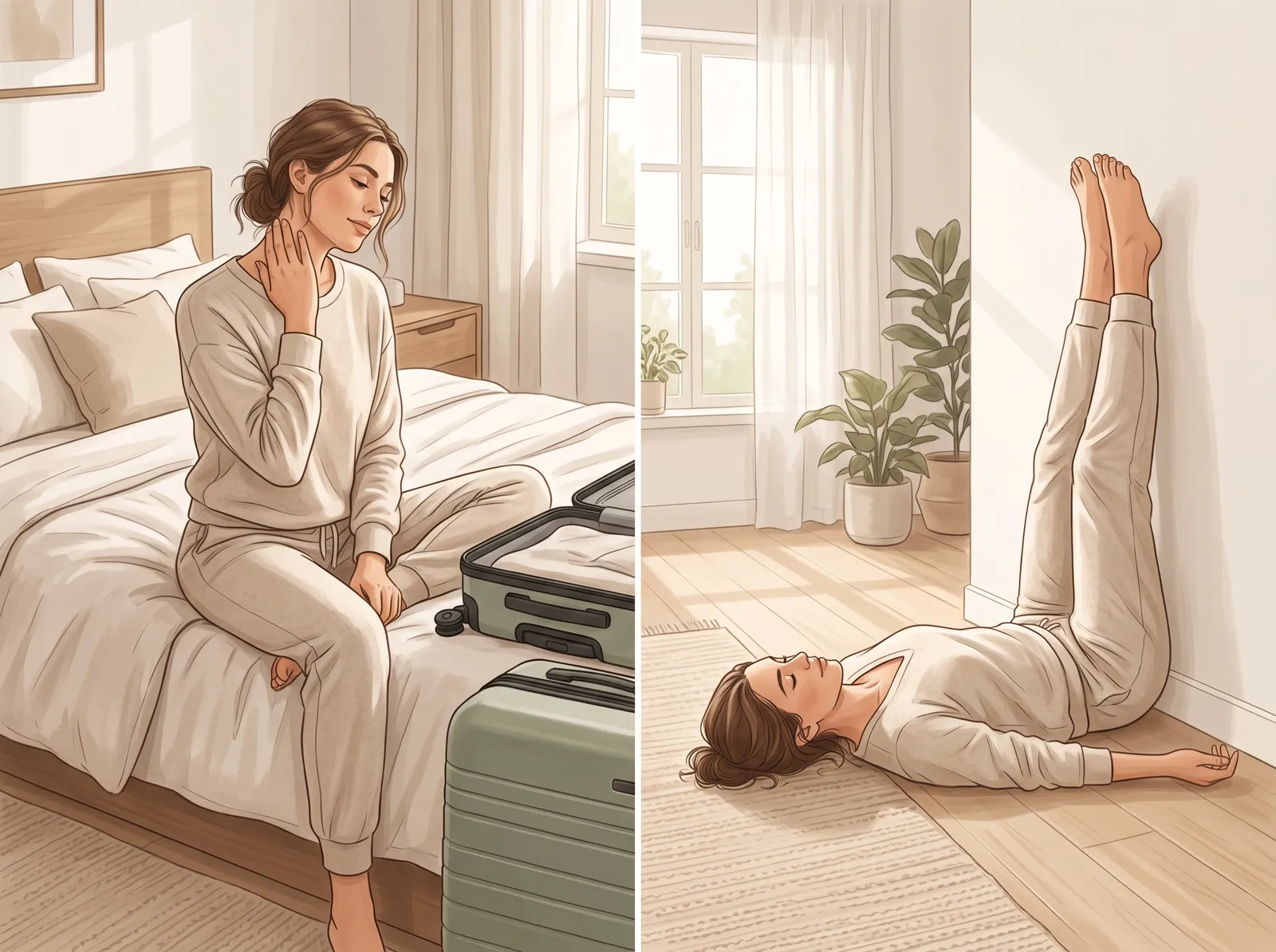
Do this the evening you land, on a bed or the floor, after a shower if you can. Pressure throughout is light enough to move skin only; if you feel muscle under your hands, you are pressing too hard. Direction and pressure are explained on the at-home hub; the short version is open the drains at the top first, then work each zone toward its nearest nodes.
1. Breathe (1 minute). One hand on the lower ribs. Five to ten slow breaths that push the belly out on the inhale and let it fall on the exhale. The diaphragm is your biggest lymph pump, and it has been shallow all flight.
2. Collarbones (30 seconds). Fingertips in the hollows above each collarbone. Ten gentle press-and-release pumps, lightly down and in toward the breastbone. This is where lymph re-enters the bloodstream; everything below depends on it being open.
3. Neck (1 minute). Flat fingers on the sides of the neck under the ears, stroking down toward the collarbones, five to seven times. Then behind the ears and down, five times. Neck before face, always: fluid from the face has to pass through here to leave. Full version on the neck page.
4. Face, outward and down (1.5 minutes). Forehead centre outward to the temples, then down the sides of the face to the jaw and neck. Under the eyes, ring-finger strokes from the inner corner outward, then down in front of the ears. Jawline from chin to ear, then down the neck. Five strokes each. This is the short form of the face routine; a cool gua sha can replace the fingers if you packed one.
5. Groin pumps (30 seconds). Lying down, fingertips in the creases where the thighs meet the torso. Ten gentle press-and-release pumps each side. The groin nodes are the first stop for everything from the legs.
6. Thigh strokes (1 minute per leg). Flat hands just above the knee. Light strokes up toward the groin along the front, outside and inside of the thigh, five to seven each.
7. Calf strokes (1 minute per leg). Gentle circles behind the knee, ten times, then strokes from the ankle up the calf to the back of the knee, five to seven each.
8. Ankle and foot (30 seconds per leg). Circle around the ankle bones, then stroke from the toes over the top of the foot to the ankle. Never push into a sore or tender calf; if one is sore, stop and re-read the red-flag box.
9. Calf pump (1 minute). Twenty slow ankle pumps (toes away, then back toward the shin), then ten ankle circles each way. This does more for airplane ankles than all the hand strokes combined, because it switches the calf muscle pump back on.
10. Legs up the wall (3 minutes or longer). Hips close to a wall, legs resting straight up it, slow breathing. Gravity now drains the ankles for free.
Drink a big glass of water afterward and expect a bathroom trip.
What to do in-flight so there is less to fix
- Ankle circles and pumps every hour. Point, flex, circle, twenty each. Set a quiet alarm if you sleep. Toes into the floor and heels up for seated calf raises.
- Walk the aisle every hour or two when the seatbelt sign allows. A trip to the galley and back fires the calf pump; travel medicine advice on avoiding clots comes down to exactly this. Lymphatic walking explains the same mechanism at home.
- Water, on your own schedule. Bring an empty bottle through security and fill it at the gate. Go easy on alcohol and very salty snacks.
- Compression socks. Graduated knee-highs (the everyday 15–20 mmHg kind sold in pharmacies), put on at home before swelling starts and worn until you land. They help the calves hold less fluid and are part of standard advice for longer flights. If you have circulation problems, diabetes or a history of clots, ask your clinician which strength is right for you.
- Aisle seat, loose shoes, uncrossed legs. Small things that add up over ten hours.
The morning-after puffy face
Face swelling usually peaks the next morning, not on landing: you were dehydrated, you ate salt, then you lay flat for hours, which moves fluid into the face and eyelids. The good news is that the face responds fastest.
Repeat steps 1 to 4 sitting up, before coffee: breathe, collarbones, neck, then face outward and down. Follow with a glass of water and a ten-minute walk (lymphatic walking: 10–20 minutes as soon as you land, before you sit again). A cold rinse at the end tightens the skin for an hour or two; it is a finishing touch, not the routine. Skip salt and alcohol for the day and the face is normally back to itself by the following morning. If mornings are your usual problem time regardless of travel, morning or night explains why the face is a morning zone. A two-minute dry brushing pass in the shower is a fine substitute for steps 5 to 8 on day two.
What to expect, honestly
Right after: lighter legs, softer ankles, a face that looks less slept-on. Next morning: shoes fit, rings turn. Within a day or two the everyday travel swelling is gone whether or not you did anything, which is worth keeping in mind. The routine makes the first day better; it does not "reset" anything and does not need repeating several times a day. See before and after for what regular practice changes, and how often for the rest of the time.
Build my plan → legs
FAQ
How to depuff after a flight?
Water, a short walk, and a ten-minute routine: open the collarbones, clear the neck and face, stroke the legs upward, finish with legs up the wall. Repeat the top half next morning for the face.
Is it normal to swell up after a flight?
Yes, if it is on both sides, painless, and better by the next morning. Swelling in one leg only, or with pain, warmth, redness or breathlessness, is not normal and needs urgent care.
How long does water retention from a flight last?
Usually a day or two once you are walking, drinking water and eating normally. If ankles are still swollen after several days, or one leg stays bigger, see a clinician.
How to get rid of "cankles" after flying?
Fire the calf pump (ankle pumps, calf raises, walking), legs up the wall for a few minutes, and light strokes from the ankle toward the knee and thigh. Compression socks on the next flight so there is less to undo.
Should I get lymphatic drainage before or after a flight?
After is where you feel the difference, because that is when the fluid has moved. A short session before can help a little; moving and hydrating during the flight helps more. The self-routine above is enough for ordinary travel puffiness.
Can I do this with poor circulation or frequent leg swelling?
Skin-level strokes, ankle pumps and elevation are gentle, but swelling that is there most days should be checked before you build a routine around it. With a heart, kidney, vein or clot history, or if you take a diuretic, ask your clinician first, and never massage a painful or one-sided leg.
Sources
- Centers for Disease Control and Prevention. CDC Yellow Book 2024: Health Information for International Travel. Chapters "Travel by Air" and "Deep Vein Thrombosis & Pulmonary Embolism" (cabin environment, immobility, travel-associated venous thromboembolism and prevention advice). wwwnc.cdc.gov/travel/yellowbook.
- Clarke MJ, Broderick C, Hopewell S, Juszczak E, Eisinga A. Compression stockings for preventing deep vein thrombosis in airline passengers. Cochrane Database Syst Rev. 2021;4:CD004002.
- Wittlinger H, Wittlinger D, Wittlinger A, Wittlinger M. Dr. Vodder's Manual Lymph Drainage: A Practical Guide. Thieme, 2011.
- Földi M, Földi E (eds). Földi's Textbook of Lymphology for Physicians and Lymphedema Therapists. 3rd ed. Elsevier Urban & Fischer, 2012.
- Ezzo J, Manheimer E, McNeely ML, et al. Manual lymphatic drainage for lymphedema following breast cancer treatment. Cochrane Database Syst Rev. 2015;(5):CD003475.
- Lymphatic Education & Research Network (LE&RN). Lymphedema and lymphatic disease: patient resources. lymphaticnetwork.org.
Lymph Plan team. Wellness information, not medical advice. One-sided calf swelling with pain, warmth or redness, or chest pain or shortness of breath after a flight, can be a blood clot: do not massage, get emergency care.